Showing posts with label Articles. Show all posts

Friday, May 14, 2010

Back to 1608 : of festivities and prodigies

The fantastic apparitions which alledgedly happened in Genoa in August 1608 has been the subject of many ufological discussions ever since the rediscovery of the French canard (chapbook) by Guy Tarade in the late 1960s. Following up on a series of discussions on the subject, I hereby present a condensed version of a much more detailed article I have been writing on the subject and in which I present some contemporary documents which might have served as a possible source of inspiration for the author of the 1608 French canard. The article is also a pretext for bringing in some thoughts about the historical and ufological treatment of 17th century prodigy literature. 

The nautical celebration on the Arno river in Florence

On the 3rd of November 1608, an amazing show was staged on the Arno river in Florence. This representation, based on the Argonautica of Appolionius of Rhodes as rewritten by Francesco Cini, was staged as part of the three weeks-long celebration of the marriage of Cosimo II de Medici and Maria Magdalena of Austria. It consisted of a naval battle complete with various vessels decorated with all sorts of mythological apparatus and a reenactment of the Golden Fleece retrieval with Cosimo in the role of Jason. The staging was as magnificent as could be Medici representations of the time and it didn't miss to impress high ranking guests from all over Europe and every beholder present that day on the banks of the Arno river.

Fortunately for us, a few accounts have survived of this splendid representation along with engravings of the scene and of the vessels. Apart from Francesco Cini’s Argonautica, the main source is a booklet by Camillo Rinuccini entitled Descrizione delle feste fatte nelle reali nozze de Serenissimi Principi di Toscana D. Cosimo de Medici e Maria Maddalena Arciduchessa d’Austria (Florence, 1608). As far as iconographical sources are concerned, an interesting engraving by Matthias Grueter representing a general view of the event on the Arno river (ill. 1) is inserted in Rinuccini’s work and independent contemporary engravings by Remigio Cantagallina and Giulio Parigi depict each of the vessels involved.

Using both these textual and iconographical sources, we can piece together an almost precise idea of what the naval event looked like. Among the twelve decorated vessels sailing on the Arno that day, four of them stand out as far as similarities with the Genoa apparitions are concerned. Here is how Rinuccini describe them:

Vessel of Iphiclus and Nauplius (ill. 2)
« Seguiva dietro a Giasone Iflico, e Nauplio, rappresentati da Adamo Ermanno di Rotnehan [sic], e dal Baron di Losenstein Tedeschi. La nave loro, per esser que’due Argonauti figliuoli di Netunno, era finta uno scoglio di spugne, pieno di coralli, e muscho, e a prua veran due cavalli marini, che mostravano tirare il carro di Nettunno, che era la poppa, e le ruote si vedevan mezze nell’acqua, e girar camminando, e sopra il Carro stava Nettuno col tridente, e a suoi piedi i Cavallieri. »(Rinuccini 1608, p. 60).

« Following [the vessel of] Jason were Iphiclus and Nauplius, represented by Adam Herman von Rotenhan and by the Baron von Losenstein, [both] Germans. The two Argonauts being sons of Neptune, their ship was made as a fake sponge rock, full of corals and moss, and at the bow were two seahorses seemingly pulling the chariot of Neptune which was the stern. The wheels which were half submerged, were turning, and on the chariot stood Neptune with [his] trident and knights at his feet. »

Vessel of Glaucus (ill. 3)
« Glauco Dio marino in questo sur’una barca spinta, e governata da Tritoni, venendo incontro a questa armata, cantando [...]. » (Rinuccini 1608, p. 63)

« Glaucus, the Sea God on a boat driven and governed by Tritons coming to meet this army [and] singing […]. »

Vessel of Idmon and Mopsus (ill. 4)
« La barca seguente era Idmone, e Mopso figliuoli, e Sacerdoti d’Apollo, il quale sedeva in poppa, sopra un bellissimo carro circondato di nugole. Il timone era governato da un vecchio, con l’ali, figurato per lo Tempo soggetto a’moti del Sole: e la prua era il Serpente Pitone, che gettava fuoco per bocca, e moveva l’ali, fra le quali, sul piano della prua, per insegna del ministerio di questi Sacerdoti, era un’altare da sacrifizii, col fuoco acceso, e tutto il d’intorno della barca, era dipinto d’animali sacri ad Apollo. » (ibid, p. 62)

« The following boat was that of Idmon and Mopsus, sons and priests of Apollo, who sat on the stern on a beautiful chariot surrounded by clouds. The rudder was governed by an old man, with wings, figurating Time subject to the motions of the Sun: and the bow was the serpent Python, which threw fire from his mouth and moved his wings, between which, on the floor of the bow, as a sign of the ministry of these priests, was a sacrificial altar, with burning fire, and all around the boat were painted animals sacred to Apollo. »

Vessel of Herakles (ill. 5)
« La prua figurava un’Idra spirante fiamma da tutte le teste, la parte di dietro della poppa ritraeva un mascherone d’un mostro, alla cui bocca era incatenato Cerbero, che serviva di timone(...) » (ibid, p.58)

« The bow figured a hydra breathing fire from every head, the part below the stern portrayed the figure of monster, to which mouth was chained Cerberus, which served as a rudder. (…) »

We might rightly object that none of the descriptions above corresponds in every detail to the description given in the canard. However, each one of them share common features with the Genoa apparitions and one can only wonder whether the author of the canard could have used the nautical festival on the Arno river clearly not as a direct source but rather as a source of inspiration.

It seems obvious enough that the horrible figures covered in scales and holding serpents of the canard do represent, or are influenced by the mythological tritons:
« […] les uns estoient en figures humaines ayant des bras qu'ils sembloient estre couverts d'escailles, & tenoyent en chacune de leurs mains deux horribles Serpens volans, qui leurs entortilloient les bras, & ne paroissoyent que depuis le nombril, en haut hors de la mer […] »
Similarities are evident enough if we compare them to the accompanying figures of Glaucus and Iphiclus vessels on the Arno, as clearly depicted on Parigi’s engraving (ill. 2 and 3) and which represent half-immerged tritons, albeit winged, holding serpentine blowing horns.

As for the Genoese chariots driven by two fiery dragon-like figures fire, these are not unlike the fire-spitting serpent Python, which is usually depicted as a dragon in 16th and 17th iconography, on the bow of the vessel of Idmon and Mopsus (ill. 4) or the fiery-eyed Hydra of the vessel of Herakles (ill. 5).
« […] trois carrosses trainant chacune par six figures toutes en feu, en semblance de dragon. Et marchoient lesdictes carrosses, l'une à l'oposite de l'autre, & estoient lesdictes carrosses trainées par lesdits signes qui avoient tousjours leurs serpens, en continuant leurs cris espouventables […] »

Rinuccini also tells us that during the course of the nautical representation, cannons were fired « in tanto numero, e in tanta varieta, che imito a pieno il vero del legni grandi, e nimici » (p. 65), while in the canard, we learn that some eight hundred cannon shots were fired at the terrible apparitions on the sea (« […] & leur fut tiré quelque huict cens coups de canon […] »).

All these graphical similarities are enough to ask ourselves whether the author of the canard could have heard about the naval representation in Florence and subsequently drew upon it for his narration, eventually changing the location and dates. While no definitive proof can be offered here, it is nonetheless certain that a major event such as this one, along with its wonderful artifices and machinery, must have struck the minds of the beholders which counted high ranking envoys from all over Europe among them. And through these officials, news of the event must have spread quickly outside Florentine territory. It is thus not improbable at all that the author of the canard knew about this particularly spectacular representation when he began writing his leaflet, either directly through a written account or by way of rumor. But the nautical spectacle of Florence having occurred on the 3rd of November 1608 and the alleged Genoa apparitions in August, we still need to check whether the canard appeared before or after the Florentine festivities.

Thanks to a mention by the Parisian chronicler Pierre de l’Estoile, we know that the canard began circulating in Paris on December 10th 1608, that is more than a month *after* the nautical battle in Florence. However, we also know that the Parisian edition of the canard printed by Pierre Menier, drew upon an earlier copy, most certainly the editio princeps, printed in Lyon. It can be assumed quite safely that the delay between the Parisian and Lyonnese edition was relatively short as information between these two major cities moved quite fast. That means that the Genoa apparition story probably first began to be circulated in France sometime in early December, or at the earliest in late November. If this assumption is correct, this would have left just about enough time for the author of the canard to hear about the Florentine representation and use it as a factual basis for his prodigious narration, only changing the date from November to August and the setting from Florence to Genoa in order to cover his tracks. This was in no way uncommon in early 17th century prodigy literature and other examples exist of date or setting changes made by the authors in order to resell their stories. Moreover, this would also explain why events in Genoa were related almost six months after they had supposedly occurred.

Capuchin miracles

And this brings us to the motivation of the author for whom we might ask what he could possibly have gained from such an enterprise, apart of course from the relatively small financial retribution such authors received upon delivering their works. On the one hand, it does not really come as a surprise that a magnificent event such as this one might have given rise to a prodigious narration, either through way of successive oral deformation or simply by awe of the event itself. But on the other, we might still ask ourselves whether the author might have followed a deliberate agenda while building up his narration.

In an earlier article, we had already noted that some elements in the text of the canard hinted toward the fact that the author might have been either a Capuchin sympathizer or a Capuchin monk himself. This was supported by the fact that he almost certainly authored a few months later, in 1609, another canard entitled «Le terrible et espouvantable dragon apparu sur l’Isle de Malte… le 15 Decembre 1608» (National Library, Paris, BN K-15938) where a teratological issue was resolved by way of Capuchin intervention, just as was the case for the 1608 Genoa apparitions.

Capuchins, which were already very influential in the Italian peninsula, were at that same time beginning to grow exponentially in France. A recent study by Dominique Varry (Varry, D. « L’introduction des Capucins en Franche-Comté et le ‘miracle’ de Faverney’ », in Autour du Miracle de Faverney (1608), Faverney, 2008), shows that the exploitation of miracles was an important component of Capuchin discourse in order to propagate their views and gain influence, most notably in the popular layers. Miracles such as the one of Faverney, which occurred in May 1608, just a few months before the alleged Genoa apparitions, could only strengthen the Capuchin reputation.
It is thus plausible that the author intended to exploit yet another striking event in such a way as to stress out to a popular public the wonders of the Capuchin order which was actively acting for the Counter-Reform. The magnificence of the celebrations of the marriage of Cosimo II and Maria-Magdalena of Austria in Florence might have given him such an opportunity.


As a final note on the subject, it is important to remember that the 17th century prodigy literature was certainly not phantasmagorical, or at least not entirely. In effect, it would certainly be wrong to consider these leaflets as mere misperceptions of natural events by some culturally « lower minded » as this approach would fail to take into account the crucial fact that in the early 17th prodigy literature, the message conveyed by a prodigy or wonder was much more important than the nature of the event itself.

Moreover, considering prodigy literature in terms of errors or deceptions would lock the historian into a «realist» approach of historiography, failing to take into consideration the contribution of this whole literature to Renaissance culture and knowledge, and failing to explain these narrations in terms other than that of« superstition » or « irrationality ».

It might seem a paradox at first sight that the ufological treatment of prodigies might be related to this historiographic «realist» approach, but in fact they are more related than meet the eye. In effect, both of them share a similar and symmetrical conception by considering prodigies as epiphenomenal reflexes. In other words, both of them acknowledge misinterpretation as the basis of their understanding of prodigious narrations and experiences for which we obviously have difficulties finding *direct* modern parallels. It is my opinion that this shared approach if applied systematically misses the main point of 17th century prodigious narration which aims less to explain the nature of a phenomenon than to understand its consequences. It is this original reading, primarily based on symbolism that we, as modern readers, should not forget when dealing with such documents lest we offer a literal reading which would be completely anachronistic and imply some kind of « magical thinking » of old as opposed to an infallible rationalistic modern approach.

As a matter of fact, the authors of the canards, those short leaflets sold in the streets, were in all probabilities and in most cases neither deliberately confabulating nor misinterpreting, but rather struggling to give sense to uncommon happenings. Many examples show that most of the time they relied upon real factual events. Sometimes these would clearly be prodigious in the strict sense of the term, but more often than not, exaggeration would follow the spread of rumor. As a consequence, lesser striking events could grow, either deliberately or not, and be reshaped into major prodigies. In fact any event that would present some irregularities compared to the normal course of nature had the potential of being considered as a prodigy as could any uncommon humanly event provide matter for a prodigious narration.

And that might have been just the case for our 1608 Genoa story. Diego Cuoghi’s earlier researches on the subject had already shown that the Genoa apparitions were with pretty good certainty a non-event as it was not corroborated by local chronicles. What remained to be understood were the motivations of the author behind his narration. While admittedly not entirely satisfactory as far as this last question is concerned, the present documents might at least offer an explanation as to the source of inspiration for the story itself.

Monday, November 16, 2009

Did Alexander the Great really see UFOs ?

Among the famous historical stories one frequently finds in ufological literature and all over the Internet is the supposed UFO sightings of Alexander the Great.

It apparently began in 1959 when American writer and broadcaster Frank Edwards wrote the following in his book Stranger than Science :

"Alexander the Great was not the first to see them nor was he the first to find them troublesome. He tells of two strange craft that dived repeatedly at his army until the war elephants, the men, and the horses all panicked and refused to cross the river where the incident occurred. What did the things look like? His historian describes them as great shining silvery shields, spitting fire around the rims... things that came from the skies and returned to the skies."
(Edwards, Frank. Stranger than Science. New York: Lyle Stuart, 1959).

Possibly inspired by Frank Edwards' claim, Alberto Fenoglio wrote in 1966 in the Italian ufological periodical Clypeus :

"During the siege of Tyre in the year 332 BC, strange flying objects were observed. Johann Gustav Droysen  in his History of Alexander the Great [Geschichte Alexanders des Grossen (1833)] does not cite it intentionally, believing it to be a fantasy of the Macedonian soldiers.
The fortress would not yield, its walls were fifty feet high and constructed so solidly that no siege-engine was able to damage it. The Tyrians disposed of the greatest technicians and builders of war-machines of the time and they intercepted in the air the incendiary arrows and projectiles hurled by the catapults on the city.
One day suddenly there appeared over the Macedonian camp these "flying shields", as they had been called, which flew in triangular formation led by an exceedingly large one, the others were smaller by almost a half. In all there were five. The unknown chronicler narrates that they circled slowly over Tyre while thousands of warriors on both sides stood and watched them in astonishment. Suddenly from the largest "shield" came a lightning-flash that struck the walls, these crumbled, other flashes followed and walls and towers dissolved, as if they had been built of mud, leaving the way open for the besiegers who poured like an avalanche through the breeches. The "flying shields" hovered over the city until it was completely stormed then they very swiftly disappeared aloft, soon melting into the blue sky."
(Fenoglio, Alberto. "Cronistoria su oggetti volanti del passato - Appunti per una clipeostoria", Clypeus no. 9 (1st semester 1966), p. 7, translated from the Italian and cited by Drake, W.R. Gods and Spacemen in Ancient Greece and Rome. London, 1976, pp. 115-116)

Unfortunately for us, neither Edwards nor Fenoglio cared to mention their sources, giving rise to decades of confusion as to the historicity of these two alleged UFO sightings by Alexander the Great and his army. 

Fenoglio's riddle being, in my opinion, the easiest to solve, I will begin by him. He says that five "flying shields" flew in triangular formation and that, after some time hovering over the walls, a lightning-flash came from the largest of these shields and struck the walls of Tyre. Unfortunately, there is no mention whatsoever of such an event outside of ufological literature. I won't even comment the laughable statement by Fenoglio who dares to say that Johann Gustav Droysen did not mention it on purpose.

However, going back to the closest sources we can get, one might ponder this quote from Quintus Curtius, one of the main classical authorities on Alexander, who says that during the siege of Tyre, in 332 BC (between January and August) :

Clipeos vero aereos multo igne torrebant, quos repletos fervida arena caenoque decocto e muris subito devolvebant. Nec ulla pestis magis timebatur: quippe, ubi loricam corpusque fervens arena penetraverat, nec ulla vi excuti poterat, et quidquid attigerat perurebat, iacientesque arma laceratis omnibus, quis protegi poterant, vulneribus inulti patebant.
(Quintus Curtius Rufus, Historia Alexandri Magni, lib. IV, cap. V)

Furthermore, they [the Tyrians] would heat bronze shields in a blazing fire, fill them with hot sand and boiling excrement and suddenly hurl them from the walls. None of their deterrents aroused greater fear than this. The hot sand would make its way between the breastplate and the body; there was no way to shake it out and it would burn through whatever it touched. The soldiers would throw away their weapons, tear off all their protective clothing and thus expose themselves to wounds without being able to retaliate.
(From Heckel, W. and Yardley, J. Alexander the Great : historical texts in translation, 2004, p. 147)

This is as close as we can get to Fenoglio's "flying shields" by looking at ancient sources and I believe this passage from Quintus Curtius is the basis Fenoglio used for his version, whether intentionally or as a result of a (hard-to-believe) misunderstanding or mistranslation.

One possibility is that Fenoglio stumbled upon this quote from Quintus Curtius while looking for the source of Frank Edwards' story. We can't tell for sure whether he considered (or intended) it to be one and the same as the latter's or just a similar but independent story but in any case, W.Raymond Drake treated both cases as two different stories, in his 1976 book, Gods and Spacemen in Ancient Greece and Rome.

A close examination of Frank Edwards' story shows that it mentions the war elephants of Alexander. Now, Alexander only began using war elephants after his successful victory over Darius III in Gaugamela (supposedly in Iraq, east of Mosul), on October 1st, 331 BC. Supposing it ever happened at all, the sighting mentioned by F. Edwards must then have occurred after that date, restricting our search to the Persian and Indian campaigns of Alexander, in between 331 and 323 BC.

Unfortunately, none of the classical historians who treated Alexander's life talk of an event who might look similar to the one described by Frank Edwards. That leaves us with the second thread of possible sources, the one which originates with the Pseudo-Callisthenes (4th century AD) and gave rise to the incredibly rich medieval genre known as the Alexander Romance. This genre which has more roots in literature than in historiography extended Alexander's life with various marvelous and prodigious events. It developed more or less independently in western Europe, the Byzantine empire and even the Arabic world, each adding its share of marvels to Alexander's life.

One of the key documents in the development of this genre is the Epistola Alexandri ad Aristotelem (the Letter of Alexander to Aristotle) which focuses on the marvels of Alexander's campaign in India. The letter itself is a fake, probably composed in the 4th or 5th century AD. It was extremely famous during the middle ages and was eventually inserted in the Pseudo-Callisthenes. A middle English version is also known to us.
The false letter of Alexander describes the marvels of India and is full of encounters with strange animals and beings, but the only celestial prodigy that is mentioned in the Epistola is the following:

Immediately after that the sky grew very black and dark, and from the dark sky there came burning fire. The fire fell to the earth like a burning torch, and the whole plain was burning from the fire's flame. Then men said that they thought it was the anger of the gods which had fallen upon us. Then I ordered old clothing to be torn up and used as a protection against the fire. After that we had a quiet and peaceful night, once our difficulties assuaged.
(Orchard, Andy.
Pride and Prodigies: Studies in the Monsters of the Beowulf Manuscript, Cambridge, 1995, p. 245)


Unfortunately, this does not compare to Frank Edwards claim. And even if it was the case, the historiographical value of the documents belonging to the Romance of Alexander genre being more than doubtful, it wouldn't account for much in terms of historicity.

We have to take note however of a striking element in F. Edwards' narration : the precision about the alleged flying crafts, these being supposedly described as "silvery shields". It comes as striking because of the name of an elite infantry unit of Alexander's army, namely the Hypaspists, who at the beginning of the campaign in India, in 326 BC, changed their names to Ἀργυράσπιδες (Argyraspides), the "silver shields", after decorating their shields with silver. The coincidence is remarkable enough to wonder whether the renaming of the Hypaspists led to a confusion between their silver shields and some supposed flying "silvery shields".

In any case, the absence of mention of such an event as the one described by Frank Edwards in any historiographical source must lead us to consider this case as extremely dubious. As a conclusion then, the bottom-line is that everything in these cases comes from unreliable and/or posterior sources with little to none historiographical value.

One might find it amusing however that, in a limited sense, the aforementioned ufo writers have somewhat become the spiritual continuators of the tradition of the Alexander Romance into our century, still adding marvelous events to it, as had done before them their medieval predecessors...

Tuesday, May 26, 2009

1608/1609 : a dragon in Malta - and its relation to the August 1608 apparitions in Genoa

The following remarks are related to a French canard entitled Discours au vrais des terribles et espouvantables signes apareus sur la Mer de Genes, first printed in 1608 in Lyon.
Recent researches made by Diego Cuoghi in the Genoan archives have shown that the story related in the above French canard does not seem to reflect any attested historical event that might have been used as a basis for the Genoan apparition narration. This was a much needed and precious verification but does not yet provide an answer as to the motives of the author. A close study of the canard literature shows that their authors very rarely invented a story from the beginning to the end but rather preferred to draw upon a less spectacular event which they embellished with fabulous details and extrapolations. This had the clear advantage of giving more credence to their narrations. Moreover, it is undeniable that some canard narratives were actually based on real phenomena. It was not unusual however to see authors re-heating older stories, or changing locations, dates and proper names in order to re-actualize a story.
With these remarks in mind and with the observation based on Diego’s own researches in the Genoan annals showing that the story cannot be linked to any recorded historical event, thus making it very dubious, the problem remains to understand why the author of the canard would choose to invent such a story and locate it in Genoa. It would seem pointless to think that the author did this without any purpose.
I recently found out that another canard published shortly after the 1608 one could bring some new information and hint as to the motives of the author.
The document entitled “Le terrible et espouvantable dragon apparu sur l’Isle de Malte… le 15 Decembre 1608” and printed in 1609 (National Library, Paris, BN K-15938) relates the story of the apparition of a seven-headed dragon in the island of Malta followed by an earthquake in December 1608.
As far as the factuality of the story narrated in the 1609 canard is concerned, as is the case for 1608 Genoa, no clear factual event can be linked to it. There is a strong symbolical element in the description of the seven-headed dragon which is reminiscent of course of the dragon of the Apocalypse and which hints toward the non-factuality of the story.
One cannot rule out however that the Maltese seven-headed dragon story was built upon a less fabulous one, eventually drawing upon local lore. Extensive research would need to be done but a first look at Maltese annals of the period, most notably the one originating from the Order of Malta, shows no mention of anything particularly wondrous in or around December 1608, even less an earthquake as is mentioned in the canard. Worthy of note however, there is a Maltese tradition of a dragon that is linked to a local place called Dragonara. This is how M. Miège describes the tradition ascribed to this place:

“Chark el Hamien est un abîme profond, situé près la cale de Saint-Georges, et là se trouve un grand réduit d’eau appelé Dragonara, à cause du bruit qui en sort, et que le peuple crédule attribue à un monstre: ce retentissement est occasionné par les évolutions de grosses anguilles qui s’y multiplient à l’infini.” (M. Miège, Histoire de Malte, tome I, Bruxelles, 1841, p. 87).


We can note that the three expressions in bold somewhat parallel the description in the canard: a monster, a terrible noise and the great number of eels which, together, might have given rise to the belief in the existence of a multiple-headed monster. But, as oral-tradition has it, it is hard to tell whether this tradition already existed in the 17th century and whether it has anything to do at all with the story related in the canard, even if the parallel is, I must admit, highly tempting.

So, as is also the case for the Genoan story, there is nothing, or almost nothing, to corroborate the factuality of the event. But, whether the stories were completely made up or whether they re-used elements from other stories, eventually relocated and re-dated, the question of the author’s motives still remains to be answered.

While the 1609 canard does not really compare to the Genoan apparitions in terms of description, many elements in the text lead to the belief that both documents may have been authored by the same person, or at least that the latter was strongly and directly influenced by the former.
In support of this view are the following extracts from the introductory matter of both documents:


« Les prodiges qui nous apparoissent sans doute ce sont courriers et postillons célestes, qui nous denoncent les malheurs advenir, et semble qu’ils nous provoquent de courir aux remedes des prieres et aux jeusnes à celle fin d’appaiser l’ire de ce grand Dieu, lequel nous offençons journellement. Les Romains aussi tost qu’ils appercevaient des prodiges ils faisoient sacrifice aux Dieux pour appaiser leurs coleres par victimes et idolatrie. Et nous qui sommes Chrestiens nourris en une meilleure escole il faut que saintement nous presentions nos cœurs contriz, et repentans et humblement prier le Tout Puissant de nous pardonner nos fautes, et vouloir appaiser sa juste colere a celle fin que les malheurs qui nous sont preparez par la justice soyent destournez et chassez loing de nous par sa saincre misericorde. » (1608 Genoa).


« Les prodiges & miracles que nous appercevons journellement, ce sont postillons de ce grand Dieu, qui nous denonce par ces avant-courriers ce qu’il nous donne à l’advenir : Mais pour appaiser l’ire de ce Tout-puissant, il faut que nous nous mettions en bon estat, pour jeusner, & le prier d’un cœur penitent, à celle fin que par nos devotes prieres il detourne de nous l’influence de ses flots & autres dards calamiteux. Au temps passé les Payens faisoient sacrifice aux Dieux lors qu’ils appercevoient des prodiges. Et nous qui sommes Chrestiens nourris en une meilleure escole, devons nous presenter à ce grand Dieu, & l’invoquer souvent avec prieres lamentables, d’un cœur contrit & humilié, pour impetrer sa grace, à celle fin qu’il nous delivre de ces tribulations qui nous preparez par sa justice. » (1609 Malta).


The similar succession of arguments as well as the use of an identical terminology betrays either a single authorship or a direct influence. The fact that both documents were printed in a very short interval from one another seems to favor the former hypothesis.

But I believe that the most interesting and instructive element of comparison between the two documents does not reside in its introductory matter and can be found inside the narrative of the apparition itself. In effect, both documents involve the intervention of Capuchin monks as the resolving factor: in the Genoan as well as the Maltese story, it is by way of Capuchin intervention that the problem is resolved.
This detail is in my opinion a possible and plausible hint as to the real motives of the author(s) of both stories.

We have to consider that Capuchins which were already influential in Italy, and well-implanted in Genoa, were at that time trying to gain influence in France. The Capuchin intervention in both stories plausibly hints to the fact that the author might have been a Capuchin sympathizer or a Capuchin himself who exploited miraculous stories in order to forge a favorable image of the Capuchin order among a French readership when it was most needed. On more speculative grounds, we can propose that the stories have been located purposely in far away regions to render them less verifiable to their French public.

In our case, it thus seems plausible to think that the author(s) intentions were to stress out to the French public the wonders of the Capuchin monks in a time when most prodigious events were interpreted as apocalyptic warnings. And even if they objectively do not bring any more factuality, or non-factuality, to the events themselves, the parallels we can draw from both documents when studied conjointly, can at least help us to understand the motivation or part of it, which led the author(s) to spread these stories and what there was to understand from them.

But, while understanding the context can offer a better comprehension as to the motives of the author, it must be stressed that it offers just that, an understanding of the perspective the text was written in. It does not offer us any definitive evidence as to the factual or non-factual nature of the events described; in effect, one could always argue that the context offered an oriented interpretation but that the events themselves had factual roots, even if these were modeled around and transformed by the interpretation and orientation the author wanted to give to his text. But while the context does not explain the nature of an event, it still offers some keys to decrypt the subjective elements of a narration.

Whether a real dragon ever roamed out the island of Malta or whether apparitions were really seen in 1608 in Genoa is obviously dubious from the absence of other sources corroborating the stories, but let’s not forget that a good number of the readers receiving such stories, believed in them, or more precisely, thought about them as believable. And that alone, was sufficient to give materiality to the narration.

Thursday, April 2, 2009

1527 : Celestial phenomenon

In 2005, Thomas Le Claire, art dealer in Hamburg, revealed in its catalog of acquisitions (Katalog no. XVII) a most rare and previously unknown piece of art. It consists of an anonymous 16th century watercolor (gouache) painting on watermarked paper depicting a celestial phenomenon (named "comet") seen in 1527 along with a hand-written descriptive text in the lower part.

Pictorial depictions of celestial phenomena were not unusual for that time frame, we know of many which were printed along with the massive popular broadsides or in more luxurious books such as, among others, Lycosthenes' Prodigiorum ac Ostentorum (1557), or Cornelius Gemma's De naturae divinis characterismis (1575). These printed depictions however were often of poor quality and reproduced from rough woodcuts.
What really stands out with the present document is not only the fact that it is original, but more importantly hand-painted, and in colors.

The watermark on the paper, representing a beetle on a small shield, was used to determine the approximative date of execution of the painting (circa 1550) and offers a hint as to the identity of the anonymous painter (Swabia, Bavaria, possibly Augsburg).

We can thus determine that the painting was not executed immediately after the event but about 25 years later. The existence of another painting (probably by the same anonymous hand), similar in execution and depicting a monstrous birth in 1513 (held by the Staatsgalerie in Stuttgart, inv. no. C 92/4097) hints toward the idea that the present painting was part of a series or album of prodigious phenomena of which only two sheets, including this one, are known today.

Various 16th century authors have mentioned a particularly spectacular celestial phenomenon in 1527 clearly visible over western Germany. Most of them talk of a "comet" but do not agree on the month: some place its appearance on August 11, others on October or December 11. All of them, except Abraham Rockenbach in his De cometis... (1598, 1602), say that the phenomenon appeared only once and lasted for less than two hours. Rockenbach however says that it was visible for many days, an hour and a half each day. Being a later account, general consensus has always considered Rockenbach as mistaken.

The only contemporary source is a small 16-page booklet written by Peter Creutzer, pupil of astrologer Johann Lichtenberger, and printed the same year (Auslegung Peter Creutzers, etwan des weytberhümbten Astrologi M. Jo. Liechtenbegers [sic] discipels über den erschrecklichen Cometen... erschynen am xi. tag Weynmonats des MCCCCCxxvii. Jars ..., n.d. [1527], n.p.). The booklet was reprinted many times in German and even translated into Latin by Gerhard Geldenhauer/Noviomagus (De terrificio cometa, cui a condito orge similis visus non est, qui apparuit anno M.D.XXVII. mense Octobri... , 1527) and in French the following year (La terrible et espoventable comete laquelle apparut le XI. Doctobre lan M.CCCCC.XXVII. en Westrie region Dalemaigne..., n.d. [1528], n.p. - Seguin no. 226 & 227).

Creutzer's text is the basis from which all other later accounts derived, and among them, the handwritten text which accompanies the present hand-painting. The latter reads as such:

Im m d xx vii Jar ist neben den commetten gesehen / vil stramen als lang spieß dar zwieschen vil angesichter vnnd klainer schwerter vermist als sich ainer bleich rotten farb / zwischen dem sach man vil grosser flamen die gantz hell vnnd feurig schinen / vnnd die angesichter hin vnnd wieder gesehen mit haar vnnd bart ainer grawen wolcken farb als legen sie im blut stramen flissenden wasser durch einander zwirblen / als ob ob es als durch ein ander arbeitet das grausam gesehen hat / als etlich dies gesehen haben die send gestorben.

[In the year 1527 the comet was seen with many streaks like long spears, and in among them, many visages and daggers, all colored in pale red, and in between many enormous flames of bright and fiery hue, and here and there the visages appeared, bearded and hairy in gray as of clouds and as if in flowing water streaked with blood, glittering and sparkling, as if everything were in confusion – the whole hideous of appearance, so that some who had seen it died thereof.]

Creutzer's booklet contains on its front-page a woodcut image illustrating his most pictorial description of the phenomenon [see ill.]. This illustration has become quite famous, and found its way in Lycosthenes' Prodigiorum ac Ostentorum... (1557), Boaistuau's Histoires prodigieuses... (1560), Ambroise Paré's Des monstres... (1573, 1585), Cornelius Gemma's De naturae divinis... (1575), and all the way to Camille Flammarion in the 19th century.

Even though the phenomenon has been labeled as a comet ever since its description by Creutzer, many scholars today tend to consider it as an auroral display, mostly because of its highly picturesque description and depiction (spears, figures, blood, etc.).

The present painting offers a different view of the event. While there are no firm elements to support the idea that the painting was based on anything else than Creutzer's original description, its representation clearly differs from the other sources known to this day, in that it is closer to the representation of a comet-like phenomenon than that of an auroral display.

We have seen earlier that all sources, except A. Rockenbach, have described the phenomenon as of single and short duration, which is mostly the basis, along with the pictorial description, of its identification as an aurora borealis. Close examination of these sources however have shown that they all used the same single source, namely Creutzer's booklet, which is also betrayed by the evident reuse of the same illustration (with very minor modifications) over time.

With the discovery of this new and exceptional document, it is now possible to ponder whether the identification as an aurora should still stand and whether more consideration should be given to Abraham Rockenbach's account which describes a longer-term phenomenon, and therefore hinting toward a more "comet-like" phenomenon.

Saturday, March 7, 2009

UFOs in the past ? About two fakes spreading around the Internet....

The subject of UFO visitations in the past has engendered quite a bunch of speculations and has a literature of its own. Jumping on this train, multiple web sites on the internet do also provide their candid visitor with catalogs of some of the most bizarre and intriguing accounts made by our predecessors.

To our delight, these sites which more often than not copy and paste one another ad nauseum without any real scholarly research, brandish a few supposedly genuine images which are meant to illustrate their point.
We shall here examine two of these illustrations which are unfortunately very widespread all over the network.

The first of them is supposed to illustrate the apparition of a UFO during the siege of the castle of "Sigisburg" (in fact Syburg) by an army of Saxons in 776 A.D. Most of the sites attribute this illustration to "a 12th century manuscript, the Annales Laurissenses, written by a monk named Laurence" :

This is not a completely wrong claim, if we except the monk Laurence part which is the result of a misunderstanding of the name of the Annals and the date which is the date of the manuscript we know them from but not of the Annals themselves (Annals were often continued over multiple centuries by multiple authors: the Annales Laurissenses which are part of the Royal Frankish Annals, Annales Regni Francorum, extends from 741 to 829).
The Annales Laurissenses indeed contain an entry for the year 776 which reads as such:
[776] [...] and the same day, while they [the Saxons] were preparing for another assault against the Christians who were living in the castle, the glory of God manifested itself above the church inside the fortress. Those who were watching in the square outside - many of which still live today - said that they saw something resembling two large flaming shields of reddish color moving above the church itself. [...] (Annales Laurissenses Maiores, in MGH SRG 6, p. 44).
So the fact that a celestial phenomenon happened in 776 A.D. during the siege of the castle of Syburg is well established by the Annales Laurissenses. Now, what about the illustrations which we can find all over the internet? Can these possibly be some miniatures from a 12th century copy of the Annals as the sites claim?

It doesn't take a medievalist to see that the illustrations are too crude to be medieval miniatures. Their style does not match 12th century ones and they don't even look like book miniatures, more like color-sprayed frescoes. This is already highly suspicious but let's pretend they are genuine and do some research on the indications the web sites have given us.

The oldest manuscript known today which contains a copy of the Annales Laurissenses is known as the Lorsch Codex. This is where the Annales Laurissenses took their name, monasterium Laureshamense being the Latin name of the Lorsch monastery. The Lorsch Codex is indeed dated from the 12th century and is most probably the one referred to when talking about the provenance of the above illustrations. A fac-simile of the manuscript has been published by Karl Glöckner in between the years 1929-1936. The 1963 reprint of this fac-simile has recently been put online on the ALO site.

Unfortunately, even if the Lorsch Codex does contain some miniatures for initials, it does not contain our beautiful world-wide-web illustrations. These must have come from elsewhere.

Hopefully, I was given the solution to my perplexity by Daniel Guenther, fellow researcher in the field, who pointed the following 13th century Spanish fresco to me. The fresco depicts the journey of the three magi on their way to Bethleem:


As we can see, the comparison speaks for itself as both illustrations are very similar. Except of course for the star of Bethleem which has been facetiously replaced by a most representative spacecraft from outer space. As a result, this illustration should now be dismissed as a modern fake. My plea in this direction to the web sites propagating the image have still remained unanswered. This kind of sites like to claim that "the horrible truth disturbs the establishment". Well, in that case at least, the truth apparently disturbs them...

But let's move on to our second illustration. This one has been labeled "842 Angers" by an unknown Photoshopic hand and is supposed, as the label says, to illustrate the apparition of a celestial phenomenon over the city of Angers in 842 A.D. At least that's how most web sites present it :


As for the Syburg image, a quick look at the illustration already brings some suspicion about its supposed date. This one looks evidently more genuine but is more than reminiscent of the woodcut illustrations that were printed in 16th and 17th century leaflets, especially the ones printed in Germany. A rapid check in this direction allowed me to find the following document which I invite you to compare with the one above :


With the exception of the coloration, both illustrations are absolutely identical, except that the one above depicts the apparition of a comet over the city of Nuremberg in October 1580 and has no relation whatsoever with Angers nor with a mid-9th century date.

The German leaflet which was printed in Nuremberg by Hans Mack is well referenced and copies of it are held by two German libraries, one in Nuremberg (GM. 2806/1204) and one in Berlin (D-4 14-8).

As most similar leaflets it is known and referred to by its title: Erinnerung und Warnung / von dem jetzt scheinenden Cometen / so im disem Monat Octobris / dess jetzt lauffenden 80. Jars / erstmals erschienen. For some unknown reason, this document, which is an interesting piece in itself, has been reused and falsely relocated in terms of time and place from Nuremberg 1580 to Angers 842.

Apart from showing how erroneous information can easily spread on the internet, these two cases illustrate the fact that many self-proclaimed researchers and proponents of the idea of UFO visitation in the past do not make the necessary verifications to the documents they use. And that's without even speaking about competences in the historical field...

Monday, August 18, 2008

Δροσουλίτες (Drosoulites, "dew-men") of Frangokastello (Crete)

While on a recent short trip in the island of Rhodes in Greece, I had the opportunity to discuss peculiar phenomena and stories with locals. Among other many interesting tales, the story of the "drosoulites" (Δροσουλίτες) caught my attention. As it might be of interest to the researches of this blog, I thought I might post a few lines about it.

The "drosoulites", is a phenomenon which is said to appear yearly at the castle of Frangokastello (Φραγκοκάστελλο, ital. Castelfranco) in the region of Sfakia in Crete. According to many local sayings, each year around the end of May, shadows of soldiers can be seen moving from the little monastery of Aghios Charalambos, passing above the castle and marching toward the sea before they disappear. The phenomenon, which is visible for about ten minutes, occurs at dawn when the air is filled with dew, hence the name "drosoulites", literally "dew-men", given by the locals. Some witnesses talk of voices and the clash of weapons being sometimes heard as well.The local belief has it that the drosoulites are the spirits of the dead Greek soldiers who lost their lives in the terrible battle that opposed Hatzimihalis Dalianis and his rebel soldiers to the ottoman army of Mustafa Paşa on the 17th of May 1828 (old style) where 337 (or 385 according to others) Greeks lost their lives. According to the local tradition, the corpses were never given proper burial and thus come back every year at the anniversary date of the fateful battle.

It is said that in 1890, a Turkish Ottoman garrison stationed in Frangokastello beheld the phenomenon and rang the alarm. The same story is repeated in 1942 when German soldiers are said to have witnessed the drosoulites and then firing at them thinking they were being attacked. A report was subsequently made to the occupying authorities in Chania who supposedly sent three higher-rank officers to Frangokastello for investigation. They apparently concluded that the phenomenon was real but was due to a rare natural occurrence. Both these stories are frequently cited in the (scarce) literature talking about the drosoulites but, to the extent of my knowledge and despite my efforts, these remain completely unverified by contemporary sources. Among other unverified but frequently cited witnesses of the phenomenon, we can also find the famous Cretan political figure, Manousos Koundouros (1860-1933) who was native of the region. Well, this is for the legend and hearsays, most of which come from older locals as nowadays reports of the appearance of the drosoulites have become scarce. Most think that the recent scarcity of the phenomenon is due to the numerous small touristic constructions that have been built in the last decade in the area around the castle.

While trying to document the phenomenon, I have found that, apart from oral testimonies, very few textual sources actually exist. Thus, it is quite hard to tell when the phenomenon actually began to be reported. In fact, the first clearly dated textual mention of the "drosoulites" I could find goes back to 1928 when a report was sent by one of the descendants of Hatzimihalis Dalianis, namely Christos Dalianis, to the President of the Athenian Εταιρεία ψυχικών ερευνών (Society of psychical researches), Angelos Tanagras. An article followed along with report and was published in the January 1929 issue of the society's journal Ψυχικαί έρευναι (Psychikai Erevnai, ie. Psychic researches) under the title "Οι "δροσουλίται" τό όραμα τών Σφακιών" (the "drosoulites", the display of Sfakia). Unfortunately, due to my short stay, I did not have the opportunity to retrieve this article from the National Library of Athens but my guess is that most of the main features of the story that spread afterwards originate from that article. This will have to be checked however and I will post an update when the article is available to me. From what I could gather though, it seems that in his article A. Tanagras considered the possibility that the phenomenon might be a kind of mirage which under favorable atmospheric conditions in the early morning could reflect scenes from the coasts of Libya (!). Tanagras, however, points out that the coasts of Libya are much too far off the coasts of Crete to be the cause of a reflection. The same explanation seems to have been proposed by an Englishman, G. Baker who heard about the phenomenon while staying in the region of Frangokastello. I could not find much information about this G. Baker except the fact that he is possibly linked to the Botanical Society of London and wrote about the phenomenon before 1961 (his study is mentioned in an article published in the Greek newspaper Ταχύδρομος (Taxydromos, May 24, 1961, p. 3).

The phenomenon of the "drosoulites", even though unnamed as such, is also mentioned in an anonymous Cretan mandinada (μαντινάδα, rhymed poem). Unfortunately, this piece is undated even though one can tell from the language characteristics that it is not recent and could easily date back to the early 20th century or before:

«Μ΄ ακόμη και το σήμερο,
στις δεκαφτά του Μάη
ούλο τα΄ ασκέρι φαίνεται με τον Χατζημιχάλη.
Και πολεμούν στα σύννεφα κι ακούγοντ΄ οι μπουρμπάδες.
Φωνές και αλογοπεταλιές στου Καστελλιού τσι μπάντες.
Ούλ΄ οι γιαλαφρόστρατοι, θωρούν τσι και τρομάζουν,
μα κείνοι Θεός σχωρέσει των, κανένα δεν πειράζουν...
αραγες κι είντα θέλουσι κι είντα μασέ θυμίζουν;
Αυτούς που σφάχτηκαν εκειά και τα βουνά ραϊζουν...»

"But still to this day, on the 17th of May,
the whole army appears with Hatzimihalis,
and they fight in the clouds and the unbelievers hear
voices and tramp of horses at the sides of the castle.
All the ghost soldiers you see and fear,
but, God have pity on them, they do not hurt anyone...
What do they wish and what do they want to be remembered ?
Those who were slaughtered there so the mountains tremble..."

Everything considered, my belief, but this is mostly speculation for now without more textual documentation, is that the story of the drosoulites did not appear before the early 20th century, eventually a decade earlier in the late 1890s. Apart from the lack of written sources for the earliest accounts, a strong hint to support this view is the fact, which I consider most puzzling, that the phenomenon is not described in Nikolaos Politis' book called Μελεταί περί τού βιού καί τής γλώσσης τού Ελληνικού λαού - Παραδόσεις A' & B' (Studies on the life and language of the Greek people - Traditions, vol. I & II) published in Athens in 1904. Politis had gone to great length in documenting local legends and folklore of every part of Greece, including Crete, and I find it hard to believe that he had not heard about the "drosoulites" of Frangokastello or did not include them in his otherwise well documented study.
Another factor which might have played a role in the development of the story of the drosoulites is the patriotic feeling that grew very strongly in this period of the early 20th century following the independence of Crete.

As a temporary conclusion to this post, I will say that, while we know of other examples from western Europe and even overseas at around the same period, the occurrence of the theme in south-eastern Europe at the beginning of the 20th century is most interesting and well worth noting.

P.S. While not very informative about the phenomenon itself, the following video offers some beautiful views of the site of Frangokastello and some historical background to the battle of 1828 :
http://www.youtube.com/watch?v=jrydIGzxk1Y

Friday, March 7, 2008

Science fiction or lost Knowledge? Cyrano, the "radio" and the art of foreshadowing Science.

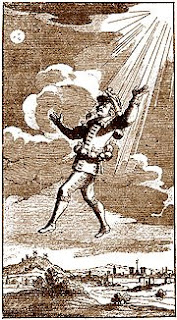
Dyrcona's ascension using flasks of morning dew. 17th century engraving.
If Hector Savinien de Cyrano (1619-1655), more commonly known as Cyrano de Bergerac, is often cited as a precursor of modern science fiction, it is mostly due to his curious and burlesque work in two parts, Histoire comique des Estats et Empires de la Lune and Histoire comique des Estats et Empires du Soleil. While these two works (which were later joined under the title L’Autre Monde) were published posthumously respectively in 1657 and 1662, it has been suggested that at least the first opus already circulated clandestinely in uncensored manuscript form as early as 1650 (Sankey 2001, p. 42).

In these two novels, Cyrano, impersonated under the anagram Dyrcona, describes his travel to the moon and the sun and portrays the idealistic societies of these two inhabited worlds. These two societies, the lunar and the solar one, are not only philosophically advanced, but also technologically. Cyrano transposes his views of an ideal society in anamorphotic way, taking advantage of the emerging debates of his time about the existence of another world on the moon to enforce his controversial views about 17th century philosophy and society.

Thomas Kuhn considered the 17th century as marking the “beginning of both popular science and science fiction” (Kuhn 1957, p. 225) and as a starting point of this new literature, the invention of the telescope and the new discoveries it allowed, played an important role.

Thus, a few decades earlier when Galileo, confirmed in this view by his precise observations with his telescope, announced in the Sidereus nuncius (1610) that the moon had mountains, seas and craters, he paved the way to posterior speculations about lunar inhabitants which he himself rejected.
Apart from philosophical discussions, these speculations quickly found their way into literary works. Early in 1621, a humorous Masque by Ben Jonson was played before King James I of England entitled News from the new world discovered in the Moon. In 1634, Kepler’s rewritten student dissertation, the Somnium, was published posthumously, which, influenced by Lucian of Samosata and Plutarch, described an imaginary travel on the moon and the meeting with its inhabitants. In 1638, Francis Godwin published The Man in the Moon, and on the same year, John Wilkins published his Discovery of a new world in the Moone to which he added a Discourse on a new planet two years later in 1640.

These works were not unknown to Cyrano who, as an erudite, was receptive to these new ideas. He had been a pupil of Gassendi and seemed to entertain a certain admiration for Descartes even though he pilloried some of his views. His frequentations had led him in the company of notorious “libertins érudits” such as La Mothe Le Vayer with whom he shared parts of his pyrrhonic skepticism.
Cyrano’s philosophical views, while sometimes hard to define precisely, are mostly a blend of the main anti-scholastic philosophical currents of his time. He is typically referred to as a “libertin” and some scholars even view him as the archetypal figure of this current, being truly a “free-thinker”.

As such, Cyrano was introduced and knowledgeable of the philosophical and scientific debates of his time, of the “new Philosophy” and the “new Science”. His two-pieces work, L’Autre Monde is a synthesis of these debates where scientific innovations rub elbows with philosophical considerations.

Cyrano, “initiate” or “contactee”

Science et Vie, no. 526 (July 1961)In July 1961, in an article entitled “Avec trois siècles d’avance, Cyrano décrivait votre poste de radio” published in the French magazine Science et Vie, Aimé Michel sought to uncover underneath some of Cyrano’s descriptions, the depiction of modern inventions, namely atomic theory, electricity, light bulbs, rockets, television and the radio.
Behind Aimé Michel’s suggestion was the idea that Cyrano could not have foreseen with such precision some of our modern machines and theories without being in contact with more knowledgeable beings, namely, in Aimé Michel’s article, extraterrestrial beings.

Coincidentally, a few months later in early 1962, Claude Mettra and Jean Suyeux published a new edition of Cyrano’s L’Autre Monde, which they inscribed in a hermetical interpretation, and a related article by Claude Mettra appeared in the French magazine Planète in September of the same year.
Mettra and Suyeux’s reading of Cyrano was in the straight line of what had already been suggested by Eugène Canseliet who already hinted to the idea that Cyrano’s text contained bribes of hidden or lost knowledge as early as 1947 in the Cahiers d’Hermès. The idea that Cyrano could have been an “initiate” (or even an “adept”, to use the precise wording of alchemical terminology) was therefore not a new idea at the time of Aimé Michel’s article. The latter however being only more precise as to the (extraterrestrial) origin of this knowledge.

From “initiate” to “contactee”, the step was short and this suggestion almost naturally found its way to ufological literature. Paul Misraki for example in Les Extraterrestres (1962) and again in Des Signes dans le Ciel (1968) follows up on Aimé Michel’s idea while incorporating ideas from E. Canseliet and C. Mettra, and suggests that Cyrano had been initiated to these secrets through connections with Rosicrucians who themselves had been initiated by “extraterrestrial messengers”.

Even more suggestive is chapter VI of Christiane Piens’ Les OVNI du passé (Verviers: Marabout, 1977, pp. 70-75) entitled “Cyrano de Bergerac fut-il contacté?” and bringing forth a possible contact between Cyrano and more advanced extra-terrestrial beings. Piens goes one step further in establishing a link between Cardan’s visitors and Cyrano’s daemon, encompassing the more general idea that Cyrano, as other great figures in history, had received knowledge from other beings, which knowledge only emerges in cryptic form in these person’s works. The idea parallels of course the hermetical interpretation.

The ideas of Paul Misraki and Aimé Michel were re-evaluated in an article published in Inforespace in May 1977 and written by Jacques Scornaux who undertook to re-examine the same passage from Cyrano’s work in which Aimé Michel had seen the description of a modern radio [documents no. 1 and no. 2].

In an earlier article, written along with Christiane Piens (“Fusées gigognes au XVIIe siècle: est-ce un mystère?” in Inforespace no. 32 (march 1977)), Scornaux had already established that the rockets described in Cyrano had a forerunner in the multi-stage rockets designed by Conrad Haas in the middle of the 16th century.

This time however, while still being mildly critical of Aimé Michel’s hypothesis (Scornaux 1977, p. 32: “Ce récit a été abondamment commenté par Aimé Michel, qui nous semble parfois y voir des choses qui n’y sont pas…”) and refusing to endorse unequivocally the latter’s view, Scornaux offers four propositions to understand how Cyrano could have known in his time about such technological wonders.
The first two propositions (knowledge acquired through Secret Societies or through extraterrestrial contacts) had already been proposed as we have seen earlier, and are quickly discarded by Scornaux as lacking material proofs.
The last two propositions (precognition or coincidence), which Scornaux seems to favor even though he does not bring much material to enforce his arguments, are on the other hand entirely new and let us, readers, the choice to consider Cyrano either as gifted with precognitive talents or as a coincidental precursor of today’s technology.

What Scornaux had not considered however is that there had already been precedents to Cyrano’s inventions and comparisons which lead us to think that this was not as coincidental as it seems.

A radio, a phonograph, a talking walnut, or...?

And indeed, Aimé Michel was the not the first to have suggested such comparisons between Cyrano’s machines and modern ones as Belgian researcher Marc Hallet has noted in his critical work entitled Critique historique et scientifique du phénomène ovni, published in 1989.

In 1877, controversies emerged on a nationalistic background to determine who, between the American Thomas Edison and the French Charles Cros, had invented the phonograph. When it became evident that Charles Cros could not be credited with a working machine, Cyrano’s “talking book” was brandished by his defenders. Thus, the text of Cyrano offered a convenient way to save face, suggesting a French spiritual inventor for an American invention, the phonograph.

Interestingly enough in regard to Aimé Michel’ suggestion, Louis Pauliat in 1890 (document no. 3) was already suggesting that Cyrano had been in contact with some kind of parallel and advanced knowledge which had been since lost:

“(…) on est comme porté à supposer qu'à côté de la science officielle pouvant exister au temps de Cyrano, c'est-à-dire de 1620 à 1655, il y en avait une autre dont plusieurs des données, totalement perdues depuis longtemps, ont été seulement retrouvées de nos jours. » (Pauliat 1890, p. 352)

Aimé Michel’s idea was indeed nothing new, if only a bit more precise as to the origin of this “lost knowledge”.

As modern readers considering these comparisons between Cyrano’s talking books, the phonograph and then the radio, we can legitimately ask ourselves how we would interpret them today, in a time where phonographs and radios with needles have become obsolete. Should we interpret Cyrano’s invention as a precursor of our portable mp3 players?

Recent researches made by Madeleine Alcover on the edition and correction of Cyrano’s L’Autre Monde have uncovered an important correction to Cyrano’s original text in regard to our matter and which earlier authors were unaware of. In the following passage,

« Quand quelqu’un donc souhaite lire, il bande, avec une grande quantité de sortes de clefs, cette machine, puis il tourne l’aiguille sur le chapitre qu’il désire écouter, et au même temps il sort de cette noix comme de la bouche d’un homme, ou d’un instrument de musique, tous les sons distincts et différents qui servent, entre les Grands lunaires, à l’expression du langage. » (Alcover 2004, pp. 136-137)

the reading “noix” (walnut) is preferred over “machine” as is suggested by the Paris manuscript. While this correction could seem insignificant, it has its importance when compared to a mention by Pliny of a specimen of the Iliad of Homer which had the size of a walnut (Pliny, Hist. Nat., VII, 21). It also helps to precise the size of these talking books and to understand how Cyrano could later attach them to his ears as pendants.

In fact, one has to consider contemporaneous documents to see that the restitution of voice through a mechanical or natural device was already discussed in Cyrano’s time as can be seen from stories such as the one reported by Charles Sorel in the Courrier Véritable of April 30, 1632, where strange bluish and greenish inhabitants of the austral lands were able to restitute sounds, music and voice through the means of sponges [document no. 4a].
Almost a century earlier, in 1552, François Rabelais had already suggested, with a tidbit of humor, a sort of natural restitution of sounds in the Quart Livre (chapters 55-56) where sounds trapped in ice due to extreme cold could be restituted by warmth [document no. 4b].

The idea of the imprisonment of sounds, to be restored at a given time, was pretty much in the air, so to speak, in Rabelais’ time. Giambattista della Porta (ca. 1535-1615) had already discussed this idea in his Magiae Naturalis (1558). Building on the example of ancient speaking statues, he deduced that cunningly engineered pipe works might be able to trap sounds, not just convey them through space:

“(…) wherefore if that voice goes with time, & hold entire, if a man as the words are spoken shall stop the end of the pipe, and he that is at the other end shall do the like, the voice may be intercepted in the middle, and be shut up as in a prison; and when the mouth is opened, the voice will come forth, as out of his mouth that spoke it; but because such long pipes cannot be made without trouble, they may be bent up and down like a trumpet, that a long pipe may be kept in a small place; and when the mouth is open, the words may be understood. I am now upon trial of it.” (Porta, English edition of 1658, p. 386)

While Porta suggested a system where sounds could be naturally “trapped” and released whenever needed, Cyrano’s “talking books” however go a step further, proposing a restitution of voice through mechanical means: “(…) il bande, avec une grande quantité de sortes de clefs, cette machine, puis il tourne l’aiguille sur le chapitre qu’il désire écouter (…)”.

Among contemporaneous experimentations and ideas on the mechanical restitution of sounds, it might be worth to consider the musical automata which were just beginning to be manufactured, particularly in the southern provinces of the Holy Roman Empire. These automata however were produced on a very small scale and destined mostly to the nobility (see Morsman 2006). This doesn’t exclude the possibility that Cyrano had heard of these.
While these automata were mostly based on the organ pipe system, it would not be surprising that Cyrano could have imagined their uses as “talking books” if they were to restitute voice instead of music.
Their mechanisms, as clockworks, could indeed have been a source of inspiration for his description.

Kircher, Athanasius. Musurgia Universalis (1650).Printed in Rome in 1650, Athanasius Kircher’s Musurgia universalis contains a variety of theories along with illustrations depicting existing and imaginary mechanical musical instruments as well as expanding on the idea of speaking statues already brought up by Giambattista della Porta (see attached plates). Recently, Madeleine Alcover suggested that Kircher’s works could have been an important source for Cyrano (Alcover 2004, p. 136, note l.2777-2788: “Le jésuite Kircher était connu pour l’intérêt qu’il portait aux machines ingénieuses; il se pourrait que son œuvre immense contienne la source des livres de la Lune »).

Would it then be so unconceivable that Cyrano could have imagined a mechanical device capable of restituting sound and voice, only by exploiting data and knowledge from his time?

Moreover, is it really necessary to invoke a lost or hidden knowledge or even an extra-terrestrial revelation to understand Cyrano’s vision of a futuristic technology?
Probably not, unless we are prepared to dismiss earlier discussions or documents which could have inspired Cyrano’s visionary inventions.

According to Madeleine Alcover (Alcover 2004, introduction), such interpretations not only dismiss and ignore all non-literary works of Cyrano but also limit themselves to a restrained choice of passages which are lighted by a re-contextualization in a specific tradition (be it hermetical or ufological) leading to a pure tautology.
In other words, by extracting specific passages from their context and by considering only a small part of an author’s works, one can easily make his point seem true.

« Rêveries scientifiques » as a mean of foreshadowing Science.

In L’Extériorisation de la sensibilité (1895), Albert de Rochas d’Aiglun who had conducted extensive studies of antique machinery and automats (among them the famous perpetual lamps) in the French periodical La Nature, includes Cyrano’s machines in a category which he calls romantically the “Rêveries scientifiques” (scientific dreams).

Even though he let the title of his Somnium (“the dream”) suggest so, Kepler was certainly not dreaming when he described in this same work the physical difficulties of a travel to the moon. While he obviously did not experiment them personally, we are nevertheless struck by the correctness of some of his descriptions of the effects of a travel through space on the human body.

In every instance the take-off hits him as a severe shock, for he is hurled just as though he had been shot aloft by gunpowder to sail over mountains and seas. For this reason at the outset he must he lulled to sleep immediately with narcotics and opiates. His limbs must be arranged in such a way that his torso will not be torn away from his buttocks nor his head from his body, but the shock will be distributed among his individual limbs. Then a new difficulty follows: extreme cold and impeded breathing. (…) When the humans wake up, they usually complain about an indescribable weariness of all their limbs, from which they later recover well enough to walk.”
(Kepler’s Somnium, translated by E. Rosen, Dover 2003, p. 16)

Kepler applied his own knowledge and theories on inertia onto an abstract case, following the principles and method of what can be qualified as a “thought experiment”, i.e. an à priori process, as opposed to an empirical one, conducted within imagination. Through this purely cognitive construction, Kepler was able to imagine the effects of inertia on a body which in turn led him to propose solutions to counter its effects.

Interesting parallels between scientific thought experiments and fictional narratives have been drawn by David Davies (see Davies 2007). Among fictional narratives, Science fiction can probably be considered as the most convenient laboratory for the most extreme of these thought experiments, comprising those hypothesis that are too speculative to be incorporated into current knowledge.

In this regard, Cyrano’s imaginary inventions could well be considered as mental constructions based on scientific and philosophical facts of his time, not unlike Jules Verne’s extraordinary machines two centuries later or today’s anticipation novels extrapolating on scientifically established facts.
Of all these inventions and theories which have been conceived, measured and constructed in these imaginary laboratories, quite a few have undoubtedly polarized the thinking of later inventors and given birth to very real creations when reason found a way to realize them.

Going back to Cyrano’s vision of lunar technology, French philosopher Michel Onfray asks the question which has been tormenting us all this long and offers this answer:

"Quelles leçons tirer de cet inventaire génial ? Que l'utopie n'est pas le lieu d'un réel impossible, mais le laboratoire de la réalité de demain; que rien n'est chimérique de ce qui relève du pensable; que l'imagination ne fonctionne pas à vide, pour rien, car elle fournit le carburant du futur; que le roman philosophique prépare parfois plus et mieux l'avenir qu'une officine de futurition autoproclamée... Et que, parfois, l'avenir se plie dans l'anamorphose." (Onfray 2007, p. 221)

A possible key to better understand Cyrano’s extraordinary machines without falling into the “pêchés des pêchés, l’anachronisme” as Lucien Febvre would say, would then be to establish the nuance between the conceivable and the feasible at a given time, the limits of the former extending much beyond the latter and driven by men’s desire, need and imagination, always a step ahead.

When in turn the conceivable, passing through the filter of reason, knowledge and technology, becomes the feasible, only then do these “scientific dreams” can become Science.


Yannis Deliyannis


-----------------------
CITED WORKS & REFERENCES


• Alcover, Madeleine. 1970. La Pensée philosophique et scientifique de Cyrano de Bergerac. Histoire des Idées et Critique Littéraire, no. 109. Paris-Geneva : Droz.
• Alcover, Madeleine (ed.). 2004. Les états et empires de la lune et du soleil : avec le Fragment de physique. Champion classiques, 1. Paris : H. Champion.
• Davies, David. 2007. « Thought Experiments and Fictional Narratives ». Croatian Journal of Philosophy, no. 19 (2007), pp. 29-45.
• De Rochas d’Aiglun, Albert. 1895. L’extériorisation de la sensibilité. Etude expérimentale et historique. Paris : Chamuel (2nd ed.).
* Hallet, Marc. 1989. Critique historique et scientifique du phénomène ovni.
• Kuhn, Thomas. 1957. The Copernican Revolution: planetary astronomy in the development of western thought. Cambridge: Harvard University Press.
• Lambert, Ladina Bezzola. 2002. Imagining the unimaginable : the poetics of early modern astronomy. Internationale Forschungen zur allgemeinen und vergleichenden Literaturwissenschaft, 58. Amsterdam : Rodopi.
• Mettra, Claude. 1962. « L’Autre monde de Cyrano de Bergerac ». Planète, no. 6 (sep.-oct. 1962), pp. 121-129.
• Michel, Aimé. 1961. « Avec trois siècles d’avance, Cyrano décrivait votre poste de radio ». Science et Vie, no. 526 (juillet 1961), pp. 90-94.
• Misraki, Paul. 1968. Des Signes dans le Ciel. Paris : Labergerie.
• Morsman, Marieke. 2006. Quicquid rarum, occultum et subtile : Augsburg musical automata around 1600. Research Master Music Studies: University of Utrecht (unpublished).
• Nédélec, Claudine. 2005. « Cyrano de Bergerac, entre Science et Fiction ». L’Information littéraire, vol. 57, no. 1 (2005), pp. 20-27.
• Onfray, Michel. 2007. Contre-histoire de la Philosophie : Les Libertins baroques. Paris : Grasset.
• Porta, Giambattista della. 1658. Natural magick. London: Printed for Thomas Young and Samuel Speed [English edition of Latin original, Magiae Naturalis, Naples, 1558].
• Sankey, Margaret. 2001. « The Paradoxes of Modernity : Rational Religion and Mythical Science in the Novels of Cyrano de Bergerac » in Crocker, R. (ed). Religion, reason and nature in early modern Europe, International archives of the history of ideas, no. 180 (2001), pp. 41-59.
• Scornaux, Jacques. 1977. « L’œuvre étrange de Cyrano de Bergerac ». Inforespace, no. 33 (mai 1977), pp. 27-35.

------------------------
DOCUMENTS

DOCUMENT no. 1
Source:

Alcover, Madeleine (ed.). 2004. Les états et empires de la lune et du soleil : avec le Fragment de physique. Champion classiques, 1. Paris : H. Champion.

A peine fut-il hors de présence que je me mis à considérer attentivement mes livres. Les boîtes, c'est-à-dire leurs couvertures, me semblèrent admirables pour leur richesse; l'une était taillée d'un seul diamant, plus brillant sans comparaison que les nôtres; la seconde ne paraissait qu'une monstrueuse perle fendue en deux. Mon démon avait traduit ces livres en langage de ce monde-là, mais parce que je n'ai point encore parlé de leur imprimerie, je m'en vais expliquer la façon de ces deux volumes.
A l'ouverture de la boîte, je trouvai dedans un je ne sais quoi de métal quasi tout semblable à nos horloges, plein d'un nombre infini de petits ressorts et machines imperceptibles. C'est un livre à la vérité, mais c'est un livre miraculeux qui n'a ni feuillets ni caractères; enfin c'est un livre où, pour apprendre, les yeux sont inutiles; on n'a besoin que d'oreilles. Quand quelqu'un donc souhaite lire, il bande, avec une grande quantité de sortes de clefs, cette machine, puis il tourne l'aiguille sur le chapitre qu'il désire écouter, et au même temps il sort de cette noix comme de la bouche d'un homme, ou d'un instrument de musique, tous les sons distincts et différents qui servent, entre les Grands lunaires, à l'expression du langage.
Lorsque j'eus réfléchi sur cette miraculeuse invention de faire des livres, je ne m'étonnai plus de voir que les jeunes hommes de ce pays-là possédaient davantage de connaissances à seize et à dix-huit ans que les barbes grises du nôtre. Car sachant lire aussitôt que parler, ils ne sont jamais sans lecture; dans la chambre, à la promenade, en ville, en voyage, à pied, à cheval, ils peuvent avoir dans la poche, ou pendus à l'arçon de leurs selles, une trentaine de ces livres dont ils n'ont qu'à bander un ressort pour en ouïr un chapitre seulement, ou bien plusieurs, s'ils sont en humeur d'écouter tout un livre. Ainsi vous avez éternellement autour de vous tous les grands hommes et morts et vivants qui vous entretiennent de vive voix.
Ce présent m'occupa plus d'une heure, et enfin, me les étant attachés en forme de pendants d'oreille, je sortis en ville pour me promener. Je n'eus pas achevé d'arpenter la rue qui tombe vis-à-vis de notre maison, que je rencontrai à l'autre bout une troupe assez nombreuse de personnes tristes.


DOCUMENT no. 2

Source :

Scornaux, Jacques. "L'œuvre étrange de Cyrano de Bergerac". Inforespace, no. 33 (mai 1977), p. 30.

Il faut maintenant évoquer l'incident qui avec celui des fusées, a fait couler le plus d'encre en ufologie : le Solaire fait don à Cyrano de deux livres provenant de son pays natal. Citons à nouveau le texte littéral :
[...]
Cette fois nous nous trouvons inéluctablement face à l'étrange, et le contexte ne permet aucune échappatoire : les paragraphes qui précèdent et qui suivent partant de tout autre chose, Cyrano enchainant abruptement sur le récit d un enterrement sur la Lune ! Plusieurs éléments de la description des « livres » sont troublants : la « couverture » qui est en fait une boite, la nature métallique de l'ensemble, les « machines imperceptibles », mais il y a surtout un détail particulièrement extraordinaire : l'aiguille que l’on tourne pour choisir un « chapitre ». Ceci ne laisse plus aucune place au doute : c'est bien un récepteur de radio qui nous est présenté. Comme le fait judicieusement remarquer Aimé Michel on pourrait encore admettre qu'un esprit imaginatif ait conçu au 17me Siècle l'idée qu'un jour la voix et la musique pourraient être conservées et reproduites artificiellement, mais, ce que Cyrano nous livre, ce n'est pas le principe de la radio, c'est bel et bien une description d'un appareil en état de marche, comme s'il l'avait eu sous les yeux. Il avoue d'ailleurs ne pas en comprendre le fonctionnement (« je n’en ai point de leur imprimerie ») et la seule grave discordance avec la réalité a justement trait a la source d'énergie : celle-ci apparaît être non l'électrivité mais un processus de détente mécanique (« je ne sais quels petits ressorts il bande, avec une grande quantité de petits nerfs, cette machine »). Sans doute Cyrano s’est-il là laissé entraîner par sa comparaison avec une horloge.
Toujours est-il que le problème est posé : personne, pas même un génie, ne pouvait prévoir il y a 300 ans l'apparence matérielle que présenterait un poste de radio... Comme l'écrit encore Aimé Michel, pour les lecteurs du 17me siècle et même encore du début du 20me, ce passage ne pouvait rien évoquer et devait apparaître comme une pure fantaisie imaginative. Et puis, soudain, le texte prend un sens précis. Cela pourrait-il être un hasard ? Nous laisserons pour l'instant la question en suspens. Notons encore que Cyrano ne donne aucun détail sur le second livre, celui qui ressemble à « une monstrueuse perle fendue en deux » : aurait-il pu s'agir là, comme le suggère Paul Misraki, d'un écran de télévision?


DOCUMENT no. 3

Source :

L’intermédiaire des chercheurs et curieux, no. 530 (10 juin 1890), pp. 351-352.

Cyrano de Bergerac, inventeur du phonographe en 1650.

Il ne se passe pas d'année, depuis la découverte du téléphone, où il ne soit question, dans une Académie quelconque de France ou de l'étranger, de la priorité de cette invention.
Tantôt elle doit être attribuée - c'est ce qui arrive le plus souvent - à tel ou tel Français, tantôt à un Belge, tantôt à un Anglais; aussi, pour la transmission du son à distance, n'accorde-t-on à M. Edison que le mérite du merveilleux instrument créé par lui. Pour l'idée première, elle lui est refusée.
En ce qui concerne le phonographe, cependant, tout le monde est porté à s'incliner tout le monde jusqu'ici semble convenir qu'il en est absolument l'auteur; et j'entends par absolument qu'il a eu à la fois l'idée de l'invention et le mérite de la mise en œuvre et de l'exécution des instruments appropriés.
Loin de moi, certes, l'intention de prétendre porter la moindre atteinte à la gloire du grand génie dont l'humanité est redevable à l'Amérique. Je dois dire toutefois que, en ce qui regarde le phonographe, j'ai des scrupules pour en accorder exclusivement la paternité à Edison.
Parcourant, en manière de distraction, le volume de Cyrano de Bergerac publié, il y a une trentaine d'années, par le bibliophile Jacob à la librairie Garnier, j'ai été frappé par un passage étrange sur lequel j'appelle l'attention de tous les savants et notamment celle de M. Edison lui-même. Le voici, au reste, afin que nos testeurs puissent se faire une opinion à ce sujet.
Ce passage est à la page 178, dans la partie du volume qui comprend le Voyage dans la lune, dont la première édition remonte à 165o.
Cyrano de Bergerac est dans la lune. Le génie qui lui tient lieu de cicerone, devant le quitter pendant quelques instants, lui prête deux livres pour lui permettre de patienter. Ces livres ont des couvertures qui leur servent de boîtes. Bergerac en prit un. Ici commence la citation :
[…]
N'y a-t-il pas là la description sommaire d'un phonographe dont les résultats étaient les mêmes que ceux du phonographe que M. Edison a inventé?
Je sais que, depuis Boileau, Cyrano de Bergerac n'a plus été pris au sérieux et qu'il est considéré, bien à tort, comme une sorte de fier-à-bras uniquement remarquable par son style empanaché et burlesque; mais si l'on rapproche cette idée du phonographe de celles des ballons et du parachute dont il est question dans ses livres (1650 à 1656) et que la science, au moins pour les ballons, n’a admises qu’en 1788, après les expériences de Montgolfier; si l'on tient compte, en outre, que Cyrano, dans un endroit de ses ouvrages explique que Mars a quatre satellites, ce qui n'est constaté scientifiquement que depuis une quinzaine d'années, - on est comme porté à supposer qu'à côté de la science officielle pouvant exister au temps de Cyrano, c'est-à-dire de 1620 à 1655, il y en avait une autre dont plusieurs des données, totalement perdues depuis longtemps, ont été seulement retrouvées de nos jours.

Louis PAULIAT


DOCUMENT no. 4a

Source:

Le Courrier véritable, du Bureau des postes estably pour les nouvelles hétérogenées, s.l. 1632. [Bibliothèque Nationale de France, BN 4-LC2-11]
Note: Republished and postdated April 23, 1643 in Charles Sorel’s Recueil du Sercy, 1644.

D’Amsterdam le 23. Avril 1632.


Le Capitaine Vosterloch est de retour de son voyage des terres Australes, qu’il avoit entre-pris par le commandement des Estats, il y a deux ans & demy. Il nous rapporte entre autres choses qu’ayant passé par un destroict au dessoubs de celuy de Magellan & de celuy du Maire, il a pris terre en un pays où les hommes sont de couleur bluastre, & les femmes de verd de mer, les cheveux des uns & des autres de Nacarat & ventre de Nonnain. Mais ce qui nous estonne d’avantage & qui nous fait admirer la nature : c’est de voir qu’au deffaut des arts liberaux & des sciences qui nous donnent le moyen de communiquer ensemble, & de descouvrir par escrit nos pensees à ceux qui sont absens, elle leur a fourni de certaines esponges qui retiennent le son & la voix articulee, comme les nostres font les liqueurs : De sorte que quand ils se veulent mander quelque choses, ou conferer deloin, ils parlent seulement de pres à quelqu’une de ces esponges, puis les envoyent à leurs amis, qui les ayant receuës, en les pressant tout doucement en font sortir ce qu’il y avoit dedans de paroles, & sçavent par cet admirable moyen tout ce que leurs amis desirent. Et pour se resjouyr quelques fois ils envoyent querir dans l’Isle Cromatique des concerts de Musique de voix, & d’instruments dans les plus fines de leurs esponges, qui leur rendent estant pressées les accords les plus delicats en leur perfection.


DOCUMENT no. 4b

Source:

Jacob, P. L. (ed.) 1854. Œuvres de François Rabelais. Paris : Bry Ainé, p. 256. [Quart livre, chap. LVI]

Comment, entre les paroles gelées, Pantagruel trouva des mots de gueule.

Le pilot feit response : « Seigneur, de rien ne vous effrayez. Ici est le confin de la mer glaciale, sus laquelle fut au commencement de l'hyver dernier passé grosse et félonne bataille, entre les Arimaspiens et les Nephelibales, lors gelarent en l'aer les paroles et cris des hommes et femmes, les chaplis des masses, les hurtis des harnois, des hardes, les hannissements des chevaulx et tout aultre effroi de combat. A ceste heure, la rigueur de l'hyver passée, advenente la sérénité et temperie du bon temps, elles fondent et sont ouïes-. — Par Dieu, dist Panurge, je l'en croi. Mais en pourrions- nous voir quelqu'une. Me soubvient avoir leu que l'orée de la montagne en laquelle Moses receut la loi des Juifs, le peuple voyoit les voix sensiblement. — Tenez, tenez, dist Pantagruel, voyez en ci qui encores ne sont desgelées. »

Lors nous jecta sus le tillac pleines mains de paroles gelées, et sembloient dragée perlée de diverses couleurs. Nous y vismes des mots de gueule, des mois de sinople, des mots d'azur, des mots de sable, des mots dores. Lesquels estre quelque peu eschauffés entre nos mains fondoient comme neiges, el les oyons réalement ; mais ne les entendions. Car c'estoit langage barbare. Excepté un assez grosset, lequel ayant frère Jean eschauffé entre ses mains, feit un son tel que font les chastaignes jectées en la braze sans estre entommées lors que s’esclatent, el nous feit touts de paour tressaillir. […]


Download original article (PDF)