Monday, August 18, 2008

Δροσουλίτες (Drosoulites, "dew-men") of Frangokastello (Crete)

While on a recent short trip in the island of Rhodes in Greece, I had the opportunity to discuss peculiar phenomena and stories with locals. Among other many interesting tales, the story of the "drosoulites" (Δροσουλίτες) caught my attention. As it might be of interest to the researches of this blog, I thought I might post a few lines about it.

The "drosoulites", is a phenomenon which is said to appear yearly at the castle of Frangokastello (Φραγκοκάστελλο, ital. Castelfranco) in the region of Sfakia in Crete. According to many local sayings, each year around the end of May, shadows of soldiers can be seen moving from the little monastery of Aghios Charalambos, passing above the castle and marching toward the sea before they disappear. The phenomenon, which is visible for about ten minutes, occurs at dawn when the air is filled with dew, hence the name "drosoulites", literally "dew-men", given by the locals. Some witnesses talk of voices and the clash of weapons being sometimes heard as well.The local belief has it that the drosoulites are the spirits of the dead Greek soldiers who lost their lives in the terrible battle that opposed Hatzimihalis Dalianis and his rebel soldiers to the ottoman army of Mustafa Paşa on the 17th of May 1828 (old style) where 337 (or 385 according to others) Greeks lost their lives. According to the local tradition, the corpses were never given proper burial and thus come back every year at the anniversary date of the fateful battle.

It is said that in 1890, a Turkish Ottoman garrison stationed in Frangokastello beheld the phenomenon and rang the alarm. The same story is repeated in 1942 when German soldiers are said to have witnessed the drosoulites and then firing at them thinking they were being attacked. A report was subsequently made to the occupying authorities in Chania who supposedly sent three higher-rank officers to Frangokastello for investigation. They apparently concluded that the phenomenon was real but was due to a rare natural occurrence. Both these stories are frequently cited in the (scarce) literature talking about the drosoulites but, to the extent of my knowledge and despite my efforts, these remain completely unverified by contemporary sources. Among other unverified but frequently cited witnesses of the phenomenon, we can also find the famous Cretan political figure, Manousos Koundouros (1860-1933) who was native of the region. Well, this is for the legend and hearsays, most of which come from older locals as nowadays reports of the appearance of the drosoulites have become scarce. Most think that the recent scarcity of the phenomenon is due to the numerous small touristic constructions that have been built in the last decade in the area around the castle.

While trying to document the phenomenon, I have found that, apart from oral testimonies, very few textual sources actually exist. Thus, it is quite hard to tell when the phenomenon actually began to be reported. In fact, the first clearly dated textual mention of the "drosoulites" I could find goes back to 1928 when a report was sent by one of the descendants of Hatzimihalis Dalianis, namely Christos Dalianis, to the President of the Athenian Εταιρεία ψυχικών ερευνών (Society of psychical researches), Angelos Tanagras. An article followed along with report and was published in the January 1929 issue of the society's journal Ψυχικαί έρευναι (Psychikai Erevnai, ie. Psychic researches) under the title "Οι "δροσουλίται" τό όραμα τών Σφακιών" (the "drosoulites", the display of Sfakia). Unfortunately, due to my short stay, I did not have the opportunity to retrieve this article from the National Library of Athens but my guess is that most of the main features of the story that spread afterwards originate from that article. This will have to be checked however and I will post an update when the article is available to me. From what I could gather though, it seems that in his article A. Tanagras considered the possibility that the phenomenon might be a kind of mirage which under favorable atmospheric conditions in the early morning could reflect scenes from the coasts of Libya (!). Tanagras, however, points out that the coasts of Libya are much too far off the coasts of Crete to be the cause of a reflection. The same explanation seems to have been proposed by an Englishman, G. Baker who heard about the phenomenon while staying in the region of Frangokastello. I could not find much information about this G. Baker except the fact that he is possibly linked to the Botanical Society of London and wrote about the phenomenon before 1961 (his study is mentioned in an article published in the Greek newspaper Ταχύδρομος (Taxydromos, May 24, 1961, p. 3).

The phenomenon of the "drosoulites", even though unnamed as such, is also mentioned in an anonymous Cretan mandinada (μαντινάδα, rhymed poem). Unfortunately, this piece is undated even though one can tell from the language characteristics that it is not recent and could easily date back to the early 20th century or before:

«Μ΄ ακόμη και το σήμερο,
στις δεκαφτά του Μάη
ούλο τα΄ ασκέρι φαίνεται με τον Χατζημιχάλη.
Και πολεμούν στα σύννεφα κι ακούγοντ΄ οι μπουρμπάδες.
Φωνές και αλογοπεταλιές στου Καστελλιού τσι μπάντες.
Ούλ΄ οι γιαλαφρόστρατοι, θωρούν τσι και τρομάζουν,
μα κείνοι Θεός σχωρέσει των, κανένα δεν πειράζουν...
αραγες κι είντα θέλουσι κι είντα μασέ θυμίζουν;
Αυτούς που σφάχτηκαν εκειά και τα βουνά ραϊζουν...»

"But still to this day, on the 17th of May,
the whole army appears with Hatzimihalis,
and they fight in the clouds and the unbelievers hear
voices and tramp of horses at the sides of the castle.
All the ghost soldiers you see and fear,
but, God have pity on them, they do not hurt anyone...
What do they wish and what do they want to be remembered ?
Those who were slaughtered there so the mountains tremble..."

Everything considered, my belief, but this is mostly speculation for now without more textual documentation, is that the story of the drosoulites did not appear before the early 20th century, eventually a decade earlier in the late 1890s. Apart from the lack of written sources for the earliest accounts, a strong hint to support this view is the fact, which I consider most puzzling, that the phenomenon is not described in Nikolaos Politis' book called Μελεταί περί τού βιού καί τής γλώσσης τού Ελληνικού λαού - Παραδόσεις A' & B' (Studies on the life and language of the Greek people - Traditions, vol. I & II) published in Athens in 1904. Politis had gone to great length in documenting local legends and folklore of every part of Greece, including Crete, and I find it hard to believe that he had not heard about the "drosoulites" of Frangokastello or did not include them in his otherwise well documented study.
Another factor which might have played a role in the development of the story of the drosoulites is the patriotic feeling that grew very strongly in this period of the early 20th century following the independence of Crete.

As a temporary conclusion to this post, I will say that, while we know of other examples from western Europe and even overseas at around the same period, the occurrence of the theme in south-eastern Europe at the beginning of the 20th century is most interesting and well worth noting.

P.S. While not very informative about the phenomenon itself, the following video offers some beautiful views of the site of Frangokastello and some historical background to the battle of 1828 :
http://www.youtube.com/watch?v=jrydIGzxk1Y

Monday, May 19, 2008

1613 : Lyon (France) - Meeting with two men dressed in black

Links between the modern "Men in Black" tradition and older narratives of meetings with the Devil or associates have been proposed many times. The following early 17th century moralistic story contains descriptive and narrative elements that could easily be linked to the modern tradition, without it being necessary to investigate whether the story is a true relation or a pure invention (which it most probably is). The most interesting piece in this document are thus the motives which can be extracted and compared to the current tradition.


Source:
Discours merveilleux et veritable, d'un Capitaine de la ville de Lyon, que Sathan a enlevé dans sa chambre, depuis peu de temps. Dedans lequel est contenu comme le tout s'est passé. Avec allegations d'Histoires sur ce subject. A Paris, par Fleury Bourriquant, 1613, pp. 9-13. [B.M. Poitiers, E183(2)]

DISCOURS
VERITABLE.

[...] Mais helas, ô horreur & frayeur ! la presente Histoire (tres-funeste & espouvantable) nous fournit un subject de ce que dessus, fort triste & lamentable, d'un de la fameuse cité de Lyon, lequel on nommoit le Capitaine Lyon, qui a esté enlevé du diable, entre dix et unze heures du soir, luy estant dans sa chambre, les fenestres & porte bien fermées: Cestuy-cy estoit de pauvre maison, presque inconnuë du commencement, & menuisier de son estat: mais estant porté d'ambition & d'orgueil, tascha d'advancer sa fortune à quelque hault degré; & quittant son mestier, s'addonna à suivre la guerre, qui estoit assez allumée en ce temps là, par la funeste ligue*: & en peu de temps (outre l'opinion commune) s'advança, sans qu'on se peust appercevoir par quel moyen il se haulsoit ainsi de jour en jour, en argent & habits de toutes sortes: tellement qu'il paroissoit, au grand estonnement d'un chacun, non pas un menuisier, ou soldat, mais comme un seigneur & grand renté gentilhomme: si bien qu'on ne parloit par la ville de Lyon, & és environs, que de ce Capitaine Lyon, qui estoit plus Capitaine de piaffe & d'orgueil, que d'armes et d'effect, changeant tous les jours de nouveaux habits, fort sumptueux: ordinairement aux tavernes, à l'exercice des cartes & des dez: l'argent en abondance, tout luy venant à souhait: heureux au jeu, ordinaire aux putains & garces, qu'il entretenoit magnifiquement, & à grands frais: brave, la moustache relevée, la queuë de cheveux pendante sur sa belle fraize, au bout de sa perruque noire, fendant l'air du bout de sa ronflante espée: bref, si plein de biens mondains & d'heur, que plusieurs portoient envie à cet imaginaire bon-heur, lequel estant arrivé à son plus hault & dernier periode, fut recognu non pas bon-heur, mais mal-heur, triste & desplorable: & a on recognu depuis que ces biens si soudainement arrivez, voire comme champignons en une nuict, estoient venus de mauvaise & illicite trafique, comme l'effect on a jugé la cause evidemment, à la veuë d'un chacun, par un hideux spectacle, qui fut tel comme s'ensuit. Le soir auquel prit fin ce bon-heur si miserable, il ferma les porte & fenestres de sa chambre: & comme il se despouilloit pour s'aller coucher, ayant dit plusieurs fois à sa femme qu'elle s'allast coucher, & elle n'y voulant neantmoins aller si tost, le voyant (outre sa coustume) fort triste, pensif & abbatu: sur ce on heurte à la porte de sa chambre, il ouvre, & voicy deux hommes habillez de noir qui se presentent, disans avoir quelque chose à luy dire: ayans parlementé ensemble, avec assez grand estrif, que la femme entendit, il se disparurentà l'instant: luy r'entra en la chambre, & ferma la porte, disans derechef à sa femme qu'elle s'allast coucher; ce qu'à son commandement elle fist: il se pourmena quelque peu par la chambre, souspirant profondement, & tout soudain ne fut plus veu, sans que porte ny fenestres fussent aucunement ouvertes: & ne resta pour enseignes de son despart & enlevement que son bonnet de nuict à terre, & ses pantoufles de chambre, qu'il avoit aux pieds: la pauvre femme demeurant toute estonnée, stupide & demy morte, ne voyant plus son mary, qu'elle venoit de perdre à sa veuë, tout soudainement cerche de tous costez, mais il ne fut plus trouvé, il estoit desja loing, il avoit des rudes charretiers qui le hastoient bien d'aller: Voila comme le diable, apres l'avoir contenté quelque temps, & repeu de vanité, l'a enlevé & mené où il a accoustumé de conduire ceux qui s'addonnans aux vanitez du monde, se donnent à luy, & luy font homage, luy donnans leur ame (qui est immortelle) pour du vent, de la bouë & de l'ordure. [...]

* : "funeste ligue" (the "funest league") here is an allusion to the Catholic League.


Sunday, May 18, 2008

Religion: The extra-terrestrial is my brother...

Doctors meeting in the University of ParisIn an interview given by Jesuit Father José Gabriel Funes to the official Vatican newspaper, L'Osservatore Romano (May 13th, 2008), the Vatican's chief Astronomer declared that "It is possible to believe in God and in extra-terrestrials".

Is this recent position of the Catholic Church a real theological revolution or has the possibility of extra-terrestrial life already been proposed in the past by Church officials ?

It has been suggested that the recent declaration of Father Funes echoes the problematic faced by Etienne Tempier, Bishop of Paris, in 1277 when he issued a condemnation of 219 philosophical and theological theses and among them the idea that God could only create one world, thus making him, to the eyes of some, an early defender of the idea of a plurality of worlds.

We believe however that, even if similarities do seem apparent, the bottom-line of the question is quite different and the debate do not share the same stakes now than then.

When Tempier condemned the idea that God have created a single World, he clearly defended the idea of God's omnipotence. Simply put, he refused to believe that God does not have the *power* of creating many worlds, which does not mean that Tempier believed in the actual existence of other worlds. The nuance, if subtle, is important because the stakes of the debate were then on defining the limits (or lack thereof) of God's capacity and not on the idea that the Universe could be populated by other living intelligent creatures, which was in total disagreement with the medieval interpretation of the Holy Scriptures.

To go even further, Tempier's condemnation is, in the history of medieval philosophy, a methodical attack against Scholasticism, nothing more. He particularly attacks Aristotle's De Caelo (which was just being rediscovered) on its assertion that the "First Cause cannot make many worlds". This was for Tempier an outrage to the omnipotent power of God who, if he had wished, could have created many worlds but did not have any reasons to do so because our world is already perfect. Thus, Tempier did not believe that other worlds existed, he only refused to believe that God do not have the power to create them. This nuance has not always been understood even though it is critical.

All told, it would certainly be wrong to consider Tempier's condemnation, and by extension the theological debates opposing medieval scholasticism, as a forerunner of the recent declaration from Father Funes on the possibility of extra-terrestrial life and its potential accordance to Christian faith, which we believe is an important re-evaluation of Christian thinking and cosmology.

Bibliography

* Bianchi, L. (1998). "1277 : a turning point in medieval philosophy ?" in Aertsen, J.A. & Speer, A. (eds). Was ist Philosophie im Mittelalter? Berlin-New York, pp. 90-110.
* Flasch, K. (1989). Aufklärung im Mittelalter? Die Verurteilung von 1277. Frankurt.
* Piché, D. (ed.) (1999). La condamnation parisienne de 1277. Texte latin, traduction, introduction et commentaire. Paris.

Thursday, April 24, 2008

Geomythology: Greek and Roman fossil-hunters ?

Geomythology is a term first coined in 1968 by the geologist Dorothy Vitaliano. It is best defined as the study of etiological traditions of pre-scientific cultures to explain geological phenomena. While the field of study is relatively new, the concept however is rather ancient and could easily be traced back to the ideas of Euhemerus.

In 2000, Adrienne Mayor published The First Fossil-hunters: Paleontology in Greek and Roman Times (Princeton University Press) in which she exposed the idea that classical traditions surrounding mythological creatures could be factually based on the mis-interpretation of paleontological remains. While the idea of the incorporation of metaphorical interpretations of fossil discoveries into myths is not in itself completely original, it was pushed further by Mayor in a way to open some new paths of exploration in Geomythology, mainly by providing convincing evidence that many paleontologic findings were indeed unearthed from sites where legendary accounts originated. A most convincing example is given for the mythological griffins which, according to Mayor, were inspired by the numerous cretaceous paleontological remains that emerge in the Gobi desert thanks to erosion.

A culminating point in Mayor' study is her re-interpretation of the scene depicted on a Late-Corinthian Crater (mid-6th century B.C.) held by the Boston Museum of Fine Arts known as the "Hesione vase". The scene shows Herakles rescuing Hesione from the "Monster of Troy". The Crater is unique in that it is the only known iconographical depiction of this legendary monster which is usually considered to represent a sea monster (ketos). Mayor instead proposes that the artist used the fossil remain of an extinct type of giant giraffe (Samotherium) as a model for the "Monster of Troy", making this vase painting the earliest iconographical attestation of a fossil. Adrienne Mayor has detailed her interpretation in an article entitled "The 'Monster of Troy' vase: the earliest artistic record of a vertebrate fossil discovery?" and published in February 2000 in the Oxford Journal of Archaeology.

In the last chapters of her book, Mayor goes on to argue that Greeks and Romans almost systematized the research of fossils which they measured, collected and even put on display after trying to reconstruct their appearance from scattered and incomplete remains, almost as modern Paleontologists do today. In my opinion, this is the weakest point of Mayor's book. As Moses I. Finley brilliantly showed in The use and abuse of History (New York: Viking Press, 1975), the Greeks had obviously the conscience that past events left a material trace in the ground but they did not systematize the research to the extent of making it a science. And indeed, the reconstruction of the past in classical times never became a pragmatical knowledge which would have led the Greek or Roman antiquaries to seek answers to their questions in the ground. Thus, the collection and display of fossil remains in classical times certainly held more of the collection of "curiosities" than of modern Paleontology as is more or less clearly suggested by Adrienne Mayor.

All in all, Mayor's thesis contains very interesting points which certainly create the need to reconsider some traditional interpretations of classical myths involving legendary monsters. As is frequent with new and ground-breaking ideas, Mayor might have sometimes gone too far in her interpretations but she certainly has opened a new research opportunity and perspective. More recently, Mayor has extended her researches to Native American history in a book entitled Fossil legends of the First Americans (Princeton University Press, 2005) which I haven't read yet. If one of our visitors had this opportunity however, I would love to hear comments about it.

Friday, March 7, 2008

Science fiction or lost Knowledge? Cyrano, the "radio" and the art of foreshadowing Science.

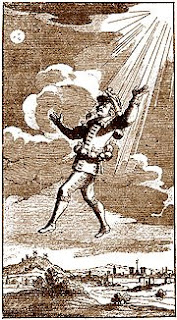
Dyrcona's ascension using flasks of morning dew. 17th century engraving.
If Hector Savinien de Cyrano (1619-1655), more commonly known as Cyrano de Bergerac, is often cited as a precursor of modern science fiction, it is mostly due to his curious and burlesque work in two parts, Histoire comique des Estats et Empires de la Lune and Histoire comique des Estats et Empires du Soleil. While these two works (which were later joined under the title L’Autre Monde) were published posthumously respectively in 1657 and 1662, it has been suggested that at least the first opus already circulated clandestinely in uncensored manuscript form as early as 1650 (Sankey 2001, p. 42).

In these two novels, Cyrano, impersonated under the anagram Dyrcona, describes his travel to the moon and the sun and portrays the idealistic societies of these two inhabited worlds. These two societies, the lunar and the solar one, are not only philosophically advanced, but also technologically. Cyrano transposes his views of an ideal society in anamorphotic way, taking advantage of the emerging debates of his time about the existence of another world on the moon to enforce his controversial views about 17th century philosophy and society.

Thomas Kuhn considered the 17th century as marking the “beginning of both popular science and science fiction” (Kuhn 1957, p. 225) and as a starting point of this new literature, the invention of the telescope and the new discoveries it allowed, played an important role.

Thus, a few decades earlier when Galileo, confirmed in this view by his precise observations with his telescope, announced in the Sidereus nuncius (1610) that the moon had mountains, seas and craters, he paved the way to posterior speculations about lunar inhabitants which he himself rejected.
Apart from philosophical discussions, these speculations quickly found their way into literary works. Early in 1621, a humorous Masque by Ben Jonson was played before King James I of England entitled News from the new world discovered in the Moon. In 1634, Kepler’s rewritten student dissertation, the Somnium, was published posthumously, which, influenced by Lucian of Samosata and Plutarch, described an imaginary travel on the moon and the meeting with its inhabitants. In 1638, Francis Godwin published The Man in the Moon, and on the same year, John Wilkins published his Discovery of a new world in the Moone to which he added a Discourse on a new planet two years later in 1640.

These works were not unknown to Cyrano who, as an erudite, was receptive to these new ideas. He had been a pupil of Gassendi and seemed to entertain a certain admiration for Descartes even though he pilloried some of his views. His frequentations had led him in the company of notorious “libertins érudits” such as La Mothe Le Vayer with whom he shared parts of his pyrrhonic skepticism.
Cyrano’s philosophical views, while sometimes hard to define precisely, are mostly a blend of the main anti-scholastic philosophical currents of his time. He is typically referred to as a “libertin” and some scholars even view him as the archetypal figure of this current, being truly a “free-thinker”.

As such, Cyrano was introduced and knowledgeable of the philosophical and scientific debates of his time, of the “new Philosophy” and the “new Science”. His two-pieces work, L’Autre Monde is a synthesis of these debates where scientific innovations rub elbows with philosophical considerations.

Cyrano, “initiate” or “contactee”

Science et Vie, no. 526 (July 1961)In July 1961, in an article entitled “Avec trois siècles d’avance, Cyrano décrivait votre poste de radio” published in the French magazine Science et Vie, Aimé Michel sought to uncover underneath some of Cyrano’s descriptions, the depiction of modern inventions, namely atomic theory, electricity, light bulbs, rockets, television and the radio.
Behind Aimé Michel’s suggestion was the idea that Cyrano could not have foreseen with such precision some of our modern machines and theories without being in contact with more knowledgeable beings, namely, in Aimé Michel’s article, extraterrestrial beings.

Coincidentally, a few months later in early 1962, Claude Mettra and Jean Suyeux published a new edition of Cyrano’s L’Autre Monde, which they inscribed in a hermetical interpretation, and a related article by Claude Mettra appeared in the French magazine Planète in September of the same year.
Mettra and Suyeux’s reading of Cyrano was in the straight line of what had already been suggested by Eugène Canseliet who already hinted to the idea that Cyrano’s text contained bribes of hidden or lost knowledge as early as 1947 in the Cahiers d’Hermès. The idea that Cyrano could have been an “initiate” (or even an “adept”, to use the precise wording of alchemical terminology) was therefore not a new idea at the time of Aimé Michel’s article. The latter however being only more precise as to the (extraterrestrial) origin of this knowledge.

From “initiate” to “contactee”, the step was short and this suggestion almost naturally found its way to ufological literature. Paul Misraki for example in Les Extraterrestres (1962) and again in Des Signes dans le Ciel (1968) follows up on Aimé Michel’s idea while incorporating ideas from E. Canseliet and C. Mettra, and suggests that Cyrano had been initiated to these secrets through connections with Rosicrucians who themselves had been initiated by “extraterrestrial messengers”.

Even more suggestive is chapter VI of Christiane Piens’ Les OVNI du passé (Verviers: Marabout, 1977, pp. 70-75) entitled “Cyrano de Bergerac fut-il contacté?” and bringing forth a possible contact between Cyrano and more advanced extra-terrestrial beings. Piens goes one step further in establishing a link between Cardan’s visitors and Cyrano’s daemon, encompassing the more general idea that Cyrano, as other great figures in history, had received knowledge from other beings, which knowledge only emerges in cryptic form in these person’s works. The idea parallels of course the hermetical interpretation.

The ideas of Paul Misraki and Aimé Michel were re-evaluated in an article published in Inforespace in May 1977 and written by Jacques Scornaux who undertook to re-examine the same passage from Cyrano’s work in which Aimé Michel had seen the description of a modern radio [documents no. 1 and no. 2].

In an earlier article, written along with Christiane Piens (“Fusées gigognes au XVIIe siècle: est-ce un mystère?” in Inforespace no. 32 (march 1977)), Scornaux had already established that the rockets described in Cyrano had a forerunner in the multi-stage rockets designed by Conrad Haas in the middle of the 16th century.

This time however, while still being mildly critical of Aimé Michel’s hypothesis (Scornaux 1977, p. 32: “Ce récit a été abondamment commenté par Aimé Michel, qui nous semble parfois y voir des choses qui n’y sont pas…”) and refusing to endorse unequivocally the latter’s view, Scornaux offers four propositions to understand how Cyrano could have known in his time about such technological wonders.
The first two propositions (knowledge acquired through Secret Societies or through extraterrestrial contacts) had already been proposed as we have seen earlier, and are quickly discarded by Scornaux as lacking material proofs.
The last two propositions (precognition or coincidence), which Scornaux seems to favor even though he does not bring much material to enforce his arguments, are on the other hand entirely new and let us, readers, the choice to consider Cyrano either as gifted with precognitive talents or as a coincidental precursor of today’s technology.

What Scornaux had not considered however is that there had already been precedents to Cyrano’s inventions and comparisons which lead us to think that this was not as coincidental as it seems.

A radio, a phonograph, a talking walnut, or...?

And indeed, Aimé Michel was the not the first to have suggested such comparisons between Cyrano’s machines and modern ones as Belgian researcher Marc Hallet has noted in his critical work entitled Critique historique et scientifique du phénomène ovni, published in 1989.

In 1877, controversies emerged on a nationalistic background to determine who, between the American Thomas Edison and the French Charles Cros, had invented the phonograph. When it became evident that Charles Cros could not be credited with a working machine, Cyrano’s “talking book” was brandished by his defenders. Thus, the text of Cyrano offered a convenient way to save face, suggesting a French spiritual inventor for an American invention, the phonograph.

Interestingly enough in regard to Aimé Michel’ suggestion, Louis Pauliat in 1890 (document no. 3) was already suggesting that Cyrano had been in contact with some kind of parallel and advanced knowledge which had been since lost:

“(…) on est comme porté à supposer qu'à côté de la science officielle pouvant exister au temps de Cyrano, c'est-à-dire de 1620 à 1655, il y en avait une autre dont plusieurs des données, totalement perdues depuis longtemps, ont été seulement retrouvées de nos jours. » (Pauliat 1890, p. 352)

Aimé Michel’s idea was indeed nothing new, if only a bit more precise as to the origin of this “lost knowledge”.

As modern readers considering these comparisons between Cyrano’s talking books, the phonograph and then the radio, we can legitimately ask ourselves how we would interpret them today, in a time where phonographs and radios with needles have become obsolete. Should we interpret Cyrano’s invention as a precursor of our portable mp3 players?

Recent researches made by Madeleine Alcover on the edition and correction of Cyrano’s L’Autre Monde have uncovered an important correction to Cyrano’s original text in regard to our matter and which earlier authors were unaware of. In the following passage,

« Quand quelqu’un donc souhaite lire, il bande, avec une grande quantité de sortes de clefs, cette machine, puis il tourne l’aiguille sur le chapitre qu’il désire écouter, et au même temps il sort de cette noix comme de la bouche d’un homme, ou d’un instrument de musique, tous les sons distincts et différents qui servent, entre les Grands lunaires, à l’expression du langage. » (Alcover 2004, pp. 136-137)

the reading “noix” (walnut) is preferred over “machine” as is suggested by the Paris manuscript. While this correction could seem insignificant, it has its importance when compared to a mention by Pliny of a specimen of the Iliad of Homer which had the size of a walnut (Pliny, Hist. Nat., VII, 21). It also helps to precise the size of these talking books and to understand how Cyrano could later attach them to his ears as pendants.

In fact, one has to consider contemporaneous documents to see that the restitution of voice through a mechanical or natural device was already discussed in Cyrano’s time as can be seen from stories such as the one reported by Charles Sorel in the Courrier Véritable of April 30, 1632, where strange bluish and greenish inhabitants of the austral lands were able to restitute sounds, music and voice through the means of sponges [document no. 4a].
Almost a century earlier, in 1552, François Rabelais had already suggested, with a tidbit of humor, a sort of natural restitution of sounds in the Quart Livre (chapters 55-56) where sounds trapped in ice due to extreme cold could be restituted by warmth [document no. 4b].

The idea of the imprisonment of sounds, to be restored at a given time, was pretty much in the air, so to speak, in Rabelais’ time. Giambattista della Porta (ca. 1535-1615) had already discussed this idea in his Magiae Naturalis (1558). Building on the example of ancient speaking statues, he deduced that cunningly engineered pipe works might be able to trap sounds, not just convey them through space:

“(…) wherefore if that voice goes with time, & hold entire, if a man as the words are spoken shall stop the end of the pipe, and he that is at the other end shall do the like, the voice may be intercepted in the middle, and be shut up as in a prison; and when the mouth is opened, the voice will come forth, as out of his mouth that spoke it; but because such long pipes cannot be made without trouble, they may be bent up and down like a trumpet, that a long pipe may be kept in a small place; and when the mouth is open, the words may be understood. I am now upon trial of it.” (Porta, English edition of 1658, p. 386)

While Porta suggested a system where sounds could be naturally “trapped” and released whenever needed, Cyrano’s “talking books” however go a step further, proposing a restitution of voice through mechanical means: “(…) il bande, avec une grande quantité de sortes de clefs, cette machine, puis il tourne l’aiguille sur le chapitre qu’il désire écouter (…)”.

Among contemporaneous experimentations and ideas on the mechanical restitution of sounds, it might be worth to consider the musical automata which were just beginning to be manufactured, particularly in the southern provinces of the Holy Roman Empire. These automata however were produced on a very small scale and destined mostly to the nobility (see Morsman 2006). This doesn’t exclude the possibility that Cyrano had heard of these.
While these automata were mostly based on the organ pipe system, it would not be surprising that Cyrano could have imagined their uses as “talking books” if they were to restitute voice instead of music.
Their mechanisms, as clockworks, could indeed have been a source of inspiration for his description.

Kircher, Athanasius. Musurgia Universalis (1650).Printed in Rome in 1650, Athanasius Kircher’s Musurgia universalis contains a variety of theories along with illustrations depicting existing and imaginary mechanical musical instruments as well as expanding on the idea of speaking statues already brought up by Giambattista della Porta (see attached plates). Recently, Madeleine Alcover suggested that Kircher’s works could have been an important source for Cyrano (Alcover 2004, p. 136, note l.2777-2788: “Le jésuite Kircher était connu pour l’intérêt qu’il portait aux machines ingénieuses; il se pourrait que son œuvre immense contienne la source des livres de la Lune »).

Would it then be so unconceivable that Cyrano could have imagined a mechanical device capable of restituting sound and voice, only by exploiting data and knowledge from his time?

Moreover, is it really necessary to invoke a lost or hidden knowledge or even an extra-terrestrial revelation to understand Cyrano’s vision of a futuristic technology?
Probably not, unless we are prepared to dismiss earlier discussions or documents which could have inspired Cyrano’s visionary inventions.

According to Madeleine Alcover (Alcover 2004, introduction), such interpretations not only dismiss and ignore all non-literary works of Cyrano but also limit themselves to a restrained choice of passages which are lighted by a re-contextualization in a specific tradition (be it hermetical or ufological) leading to a pure tautology.
In other words, by extracting specific passages from their context and by considering only a small part of an author’s works, one can easily make his point seem true.

« Rêveries scientifiques » as a mean of foreshadowing Science.

In L’Extériorisation de la sensibilité (1895), Albert de Rochas d’Aiglun who had conducted extensive studies of antique machinery and automats (among them the famous perpetual lamps) in the French periodical La Nature, includes Cyrano’s machines in a category which he calls romantically the “Rêveries scientifiques” (scientific dreams).

Even though he let the title of his Somnium (“the dream”) suggest so, Kepler was certainly not dreaming when he described in this same work the physical difficulties of a travel to the moon. While he obviously did not experiment them personally, we are nevertheless struck by the correctness of some of his descriptions of the effects of a travel through space on the human body.

In every instance the take-off hits him as a severe shock, for he is hurled just as though he had been shot aloft by gunpowder to sail over mountains and seas. For this reason at the outset he must he lulled to sleep immediately with narcotics and opiates. His limbs must be arranged in such a way that his torso will not be torn away from his buttocks nor his head from his body, but the shock will be distributed among his individual limbs. Then a new difficulty follows: extreme cold and impeded breathing. (…) When the humans wake up, they usually complain about an indescribable weariness of all their limbs, from which they later recover well enough to walk.”
(Kepler’s Somnium, translated by E. Rosen, Dover 2003, p. 16)

Kepler applied his own knowledge and theories on inertia onto an abstract case, following the principles and method of what can be qualified as a “thought experiment”, i.e. an à priori process, as opposed to an empirical one, conducted within imagination. Through this purely cognitive construction, Kepler was able to imagine the effects of inertia on a body which in turn led him to propose solutions to counter its effects.

Interesting parallels between scientific thought experiments and fictional narratives have been drawn by David Davies (see Davies 2007). Among fictional narratives, Science fiction can probably be considered as the most convenient laboratory for the most extreme of these thought experiments, comprising those hypothesis that are too speculative to be incorporated into current knowledge.

In this regard, Cyrano’s imaginary inventions could well be considered as mental constructions based on scientific and philosophical facts of his time, not unlike Jules Verne’s extraordinary machines two centuries later or today’s anticipation novels extrapolating on scientifically established facts.
Of all these inventions and theories which have been conceived, measured and constructed in these imaginary laboratories, quite a few have undoubtedly polarized the thinking of later inventors and given birth to very real creations when reason found a way to realize them.

Going back to Cyrano’s vision of lunar technology, French philosopher Michel Onfray asks the question which has been tormenting us all this long and offers this answer:

"Quelles leçons tirer de cet inventaire génial ? Que l'utopie n'est pas le lieu d'un réel impossible, mais le laboratoire de la réalité de demain; que rien n'est chimérique de ce qui relève du pensable; que l'imagination ne fonctionne pas à vide, pour rien, car elle fournit le carburant du futur; que le roman philosophique prépare parfois plus et mieux l'avenir qu'une officine de futurition autoproclamée... Et que, parfois, l'avenir se plie dans l'anamorphose." (Onfray 2007, p. 221)

A possible key to better understand Cyrano’s extraordinary machines without falling into the “pêchés des pêchés, l’anachronisme” as Lucien Febvre would say, would then be to establish the nuance between the conceivable and the feasible at a given time, the limits of the former extending much beyond the latter and driven by men’s desire, need and imagination, always a step ahead.

When in turn the conceivable, passing through the filter of reason, knowledge and technology, becomes the feasible, only then do these “scientific dreams” can become Science.


Yannis Deliyannis


-----------------------
CITED WORKS & REFERENCES


• Alcover, Madeleine. 1970. La Pensée philosophique et scientifique de Cyrano de Bergerac. Histoire des Idées et Critique Littéraire, no. 109. Paris-Geneva : Droz.
• Alcover, Madeleine (ed.). 2004. Les états et empires de la lune et du soleil : avec le Fragment de physique. Champion classiques, 1. Paris : H. Champion.
• Davies, David. 2007. « Thought Experiments and Fictional Narratives ». Croatian Journal of Philosophy, no. 19 (2007), pp. 29-45.
• De Rochas d’Aiglun, Albert. 1895. L’extériorisation de la sensibilité. Etude expérimentale et historique. Paris : Chamuel (2nd ed.).
* Hallet, Marc. 1989. Critique historique et scientifique du phénomène ovni.
• Kuhn, Thomas. 1957. The Copernican Revolution: planetary astronomy in the development of western thought. Cambridge: Harvard University Press.
• Lambert, Ladina Bezzola. 2002. Imagining the unimaginable : the poetics of early modern astronomy. Internationale Forschungen zur allgemeinen und vergleichenden Literaturwissenschaft, 58. Amsterdam : Rodopi.
• Mettra, Claude. 1962. « L’Autre monde de Cyrano de Bergerac ». Planète, no. 6 (sep.-oct. 1962), pp. 121-129.
• Michel, Aimé. 1961. « Avec trois siècles d’avance, Cyrano décrivait votre poste de radio ». Science et Vie, no. 526 (juillet 1961), pp. 90-94.
• Misraki, Paul. 1968. Des Signes dans le Ciel. Paris : Labergerie.
• Morsman, Marieke. 2006. Quicquid rarum, occultum et subtile : Augsburg musical automata around 1600. Research Master Music Studies: University of Utrecht (unpublished).
• Nédélec, Claudine. 2005. « Cyrano de Bergerac, entre Science et Fiction ». L’Information littéraire, vol. 57, no. 1 (2005), pp. 20-27.
• Onfray, Michel. 2007. Contre-histoire de la Philosophie : Les Libertins baroques. Paris : Grasset.
• Porta, Giambattista della. 1658. Natural magick. London: Printed for Thomas Young and Samuel Speed [English edition of Latin original, Magiae Naturalis, Naples, 1558].
• Sankey, Margaret. 2001. « The Paradoxes of Modernity : Rational Religion and Mythical Science in the Novels of Cyrano de Bergerac » in Crocker, R. (ed). Religion, reason and nature in early modern Europe, International archives of the history of ideas, no. 180 (2001), pp. 41-59.
• Scornaux, Jacques. 1977. « L’œuvre étrange de Cyrano de Bergerac ». Inforespace, no. 33 (mai 1977), pp. 27-35.

------------------------
DOCUMENTS

DOCUMENT no. 1
Source:

Alcover, Madeleine (ed.). 2004. Les états et empires de la lune et du soleil : avec le Fragment de physique. Champion classiques, 1. Paris : H. Champion.

A peine fut-il hors de présence que je me mis à considérer attentivement mes livres. Les boîtes, c'est-à-dire leurs couvertures, me semblèrent admirables pour leur richesse; l'une était taillée d'un seul diamant, plus brillant sans comparaison que les nôtres; la seconde ne paraissait qu'une monstrueuse perle fendue en deux. Mon démon avait traduit ces livres en langage de ce monde-là, mais parce que je n'ai point encore parlé de leur imprimerie, je m'en vais expliquer la façon de ces deux volumes.
A l'ouverture de la boîte, je trouvai dedans un je ne sais quoi de métal quasi tout semblable à nos horloges, plein d'un nombre infini de petits ressorts et machines imperceptibles. C'est un livre à la vérité, mais c'est un livre miraculeux qui n'a ni feuillets ni caractères; enfin c'est un livre où, pour apprendre, les yeux sont inutiles; on n'a besoin que d'oreilles. Quand quelqu'un donc souhaite lire, il bande, avec une grande quantité de sortes de clefs, cette machine, puis il tourne l'aiguille sur le chapitre qu'il désire écouter, et au même temps il sort de cette noix comme de la bouche d'un homme, ou d'un instrument de musique, tous les sons distincts et différents qui servent, entre les Grands lunaires, à l'expression du langage.
Lorsque j'eus réfléchi sur cette miraculeuse invention de faire des livres, je ne m'étonnai plus de voir que les jeunes hommes de ce pays-là possédaient davantage de connaissances à seize et à dix-huit ans que les barbes grises du nôtre. Car sachant lire aussitôt que parler, ils ne sont jamais sans lecture; dans la chambre, à la promenade, en ville, en voyage, à pied, à cheval, ils peuvent avoir dans la poche, ou pendus à l'arçon de leurs selles, une trentaine de ces livres dont ils n'ont qu'à bander un ressort pour en ouïr un chapitre seulement, ou bien plusieurs, s'ils sont en humeur d'écouter tout un livre. Ainsi vous avez éternellement autour de vous tous les grands hommes et morts et vivants qui vous entretiennent de vive voix.
Ce présent m'occupa plus d'une heure, et enfin, me les étant attachés en forme de pendants d'oreille, je sortis en ville pour me promener. Je n'eus pas achevé d'arpenter la rue qui tombe vis-à-vis de notre maison, que je rencontrai à l'autre bout une troupe assez nombreuse de personnes tristes.


DOCUMENT no. 2

Source :

Scornaux, Jacques. "L'œuvre étrange de Cyrano de Bergerac". Inforespace, no. 33 (mai 1977), p. 30.

Il faut maintenant évoquer l'incident qui avec celui des fusées, a fait couler le plus d'encre en ufologie : le Solaire fait don à Cyrano de deux livres provenant de son pays natal. Citons à nouveau le texte littéral :
[...]
Cette fois nous nous trouvons inéluctablement face à l'étrange, et le contexte ne permet aucune échappatoire : les paragraphes qui précèdent et qui suivent partant de tout autre chose, Cyrano enchainant abruptement sur le récit d un enterrement sur la Lune ! Plusieurs éléments de la description des « livres » sont troublants : la « couverture » qui est en fait une boite, la nature métallique de l'ensemble, les « machines imperceptibles », mais il y a surtout un détail particulièrement extraordinaire : l'aiguille que l’on tourne pour choisir un « chapitre ». Ceci ne laisse plus aucune place au doute : c'est bien un récepteur de radio qui nous est présenté. Comme le fait judicieusement remarquer Aimé Michel on pourrait encore admettre qu'un esprit imaginatif ait conçu au 17me Siècle l'idée qu'un jour la voix et la musique pourraient être conservées et reproduites artificiellement, mais, ce que Cyrano nous livre, ce n'est pas le principe de la radio, c'est bel et bien une description d'un appareil en état de marche, comme s'il l'avait eu sous les yeux. Il avoue d'ailleurs ne pas en comprendre le fonctionnement (« je n’en ai point de leur imprimerie ») et la seule grave discordance avec la réalité a justement trait a la source d'énergie : celle-ci apparaît être non l'électrivité mais un processus de détente mécanique (« je ne sais quels petits ressorts il bande, avec une grande quantité de petits nerfs, cette machine »). Sans doute Cyrano s’est-il là laissé entraîner par sa comparaison avec une horloge.
Toujours est-il que le problème est posé : personne, pas même un génie, ne pouvait prévoir il y a 300 ans l'apparence matérielle que présenterait un poste de radio... Comme l'écrit encore Aimé Michel, pour les lecteurs du 17me siècle et même encore du début du 20me, ce passage ne pouvait rien évoquer et devait apparaître comme une pure fantaisie imaginative. Et puis, soudain, le texte prend un sens précis. Cela pourrait-il être un hasard ? Nous laisserons pour l'instant la question en suspens. Notons encore que Cyrano ne donne aucun détail sur le second livre, celui qui ressemble à « une monstrueuse perle fendue en deux » : aurait-il pu s'agir là, comme le suggère Paul Misraki, d'un écran de télévision?


DOCUMENT no. 3

Source :

L’intermédiaire des chercheurs et curieux, no. 530 (10 juin 1890), pp. 351-352.

Cyrano de Bergerac, inventeur du phonographe en 1650.

Il ne se passe pas d'année, depuis la découverte du téléphone, où il ne soit question, dans une Académie quelconque de France ou de l'étranger, de la priorité de cette invention.
Tantôt elle doit être attribuée - c'est ce qui arrive le plus souvent - à tel ou tel Français, tantôt à un Belge, tantôt à un Anglais; aussi, pour la transmission du son à distance, n'accorde-t-on à M. Edison que le mérite du merveilleux instrument créé par lui. Pour l'idée première, elle lui est refusée.
En ce qui concerne le phonographe, cependant, tout le monde est porté à s'incliner tout le monde jusqu'ici semble convenir qu'il en est absolument l'auteur; et j'entends par absolument qu'il a eu à la fois l'idée de l'invention et le mérite de la mise en œuvre et de l'exécution des instruments appropriés.
Loin de moi, certes, l'intention de prétendre porter la moindre atteinte à la gloire du grand génie dont l'humanité est redevable à l'Amérique. Je dois dire toutefois que, en ce qui regarde le phonographe, j'ai des scrupules pour en accorder exclusivement la paternité à Edison.
Parcourant, en manière de distraction, le volume de Cyrano de Bergerac publié, il y a une trentaine d'années, par le bibliophile Jacob à la librairie Garnier, j'ai été frappé par un passage étrange sur lequel j'appelle l'attention de tous les savants et notamment celle de M. Edison lui-même. Le voici, au reste, afin que nos testeurs puissent se faire une opinion à ce sujet.
Ce passage est à la page 178, dans la partie du volume qui comprend le Voyage dans la lune, dont la première édition remonte à 165o.
Cyrano de Bergerac est dans la lune. Le génie qui lui tient lieu de cicerone, devant le quitter pendant quelques instants, lui prête deux livres pour lui permettre de patienter. Ces livres ont des couvertures qui leur servent de boîtes. Bergerac en prit un. Ici commence la citation :
[…]
N'y a-t-il pas là la description sommaire d'un phonographe dont les résultats étaient les mêmes que ceux du phonographe que M. Edison a inventé?
Je sais que, depuis Boileau, Cyrano de Bergerac n'a plus été pris au sérieux et qu'il est considéré, bien à tort, comme une sorte de fier-à-bras uniquement remarquable par son style empanaché et burlesque; mais si l'on rapproche cette idée du phonographe de celles des ballons et du parachute dont il est question dans ses livres (1650 à 1656) et que la science, au moins pour les ballons, n’a admises qu’en 1788, après les expériences de Montgolfier; si l'on tient compte, en outre, que Cyrano, dans un endroit de ses ouvrages explique que Mars a quatre satellites, ce qui n'est constaté scientifiquement que depuis une quinzaine d'années, - on est comme porté à supposer qu'à côté de la science officielle pouvant exister au temps de Cyrano, c'est-à-dire de 1620 à 1655, il y en avait une autre dont plusieurs des données, totalement perdues depuis longtemps, ont été seulement retrouvées de nos jours.

Louis PAULIAT


DOCUMENT no. 4a

Source:

Le Courrier véritable, du Bureau des postes estably pour les nouvelles hétérogenées, s.l. 1632. [Bibliothèque Nationale de France, BN 4-LC2-11]
Note: Republished and postdated April 23, 1643 in Charles Sorel’s Recueil du Sercy, 1644.

D’Amsterdam le 23. Avril 1632.


Le Capitaine Vosterloch est de retour de son voyage des terres Australes, qu’il avoit entre-pris par le commandement des Estats, il y a deux ans & demy. Il nous rapporte entre autres choses qu’ayant passé par un destroict au dessoubs de celuy de Magellan & de celuy du Maire, il a pris terre en un pays où les hommes sont de couleur bluastre, & les femmes de verd de mer, les cheveux des uns & des autres de Nacarat & ventre de Nonnain. Mais ce qui nous estonne d’avantage & qui nous fait admirer la nature : c’est de voir qu’au deffaut des arts liberaux & des sciences qui nous donnent le moyen de communiquer ensemble, & de descouvrir par escrit nos pensees à ceux qui sont absens, elle leur a fourni de certaines esponges qui retiennent le son & la voix articulee, comme les nostres font les liqueurs : De sorte que quand ils se veulent mander quelque choses, ou conferer deloin, ils parlent seulement de pres à quelqu’une de ces esponges, puis les envoyent à leurs amis, qui les ayant receuës, en les pressant tout doucement en font sortir ce qu’il y avoit dedans de paroles, & sçavent par cet admirable moyen tout ce que leurs amis desirent. Et pour se resjouyr quelques fois ils envoyent querir dans l’Isle Cromatique des concerts de Musique de voix, & d’instruments dans les plus fines de leurs esponges, qui leur rendent estant pressées les accords les plus delicats en leur perfection.


DOCUMENT no. 4b

Source:

Jacob, P. L. (ed.) 1854. Œuvres de François Rabelais. Paris : Bry Ainé, p. 256. [Quart livre, chap. LVI]

Comment, entre les paroles gelées, Pantagruel trouva des mots de gueule.

Le pilot feit response : « Seigneur, de rien ne vous effrayez. Ici est le confin de la mer glaciale, sus laquelle fut au commencement de l'hyver dernier passé grosse et félonne bataille, entre les Arimaspiens et les Nephelibales, lors gelarent en l'aer les paroles et cris des hommes et femmes, les chaplis des masses, les hurtis des harnois, des hardes, les hannissements des chevaulx et tout aultre effroi de combat. A ceste heure, la rigueur de l'hyver passée, advenente la sérénité et temperie du bon temps, elles fondent et sont ouïes-. — Par Dieu, dist Panurge, je l'en croi. Mais en pourrions- nous voir quelqu'une. Me soubvient avoir leu que l'orée de la montagne en laquelle Moses receut la loi des Juifs, le peuple voyoit les voix sensiblement. — Tenez, tenez, dist Pantagruel, voyez en ci qui encores ne sont desgelées. »

Lors nous jecta sus le tillac pleines mains de paroles gelées, et sembloient dragée perlée de diverses couleurs. Nous y vismes des mots de gueule, des mois de sinople, des mots d'azur, des mots de sable, des mots dores. Lesquels estre quelque peu eschauffés entre nos mains fondoient comme neiges, el les oyons réalement ; mais ne les entendions. Car c'estoit langage barbare. Excepté un assez grosset, lequel ayant frère Jean eschauffé entre ses mains, feit un son tel que font les chastaignes jectées en la braze sans estre entommées lors que s’esclatent, el nous feit touts de paour tressaillir. […]


Download original article (PDF)

Wednesday, February 27, 2008

Philosophical skepticism and Science in 17th century France: the case of La Mothe Le Vayer.

Following the recent post about 17th century discussions on the link between Celestial Battles and Auroras, championed, in the example I used, by Gassendi, I hereby propose another series of documents which aim to show how these discussions were extended in philosophical debates in the first half of the 17th century and in what context they appeared. Of course, the scope of these debates is much larger than what I can decently present here and we can only patch up together pieces of more general puzzle which will need to be completed by subsequent studies. Thus, in this incomplete study, I chose to concentrate on a particular case which can be compared for similarities and differences with Gassendi's approach and which has ramifications into more general philosophical debates and controversies on theology and science.

We have seen in the previous post how Gassendi's own observations led him to recognize Auroras in a phenomenon which was described by others as Celestial Battles. Gassendi's philosophical inclinations, based on doubt and advocating a skepticism holding that knowledge could be received only through the senses, experiment and observation, were a determining factor in his own account and study of the phenomenon.

The renewal of philosophical skepticism during the 17th century is an important key to understand philosophical debates which later led to the Enlightenment and the birth of modern science. Popkin and others have already underlined the importance of this factor in their fundamental studies on the subject (see references below).

Building up on Montaigne's teachings, a current of thought emerged in the last quarter of the 16th and first half of the 17th century which, helped by the rediscovery of Sextus Empiricus' writings, led to a modern avatar of the antic Pyrrhonian thought.

As Popkin have already noted (Popkin 2003, pp. 77 et al.), this new Pyrrhonism played an important role in the theological struggles of the time but also had an effect on controversies about pseudo sciences such as astrology, alchemy, sorcery, etc. which benefited from the decline of Aristotelian science. Typical of these debates are the dialogs between a skeptic, an alchemist and a Christian philosopher set up by Marin Mersenne in his Vérité des Sciences contre les sceptiques, [1625], and where he leads a double attack on alchemy and skepticism by using the latter's arguments against the former.

As a matter of fact, Pyrrhonism and its arguments were often used by non-Pyrrhonists, mainly as a rhetorical tool to attack Aristotelianism. Gassendi, more of an Epicurean himself and only a moderate skeptic, used for example Pyrrhonian critique of sense knowledge to attack Aristotelianism in his Exercitationes paradoxicae adversus Aristoteleos (1649) in order to defend his epistemological view based on Epicurean Atomism. As noted by Popkin: "The nouveau pyrrhonisme was to envelop all the human sciences and philosophy in a complete skeptical crisis, out of which modern philosophy and the scientific outlook finally emerged" (Popkin 2003, p. 79).

Mersenne and Gassendi situated themselves between the extremes of dogmatism (both Aristotelian and Cartesian) and Pyrrhonist skepticism. Gassendi criticized the exaggeration of the power of human mind typical of dogmatism while attacking the skeptics for adopting the opposite extreme. According to Gassendi, while senses could prove to be unreliable, they could be corrected. By proposing a new epistemological view of nature based on Epicurean atomism, where atoms were created and set in motion by God, Gassendi presented a middle ground for natural philosophy in the seventeenth century.

In parallel to this critique of Scholastic and Aristotelian science as well as of the pseudo sciences, Pyrrhonism was also used to attack the "new science" itself. "Humanistic skeptics" or "Libertins érudits" such as La Mothe Le Vayer and Samuel Sorbière, regarded this new science as a dogmatism as dangerous as the former ones and all scientific research as "a form of human arrogance and impiety, which ought to be abandoned for complete doubt and pure fideism" (Popkin 2003, p. 79).

François de La Mothe Le Vayer (1588-1672) was one of the principal figures of this Pyrrhonian renewal in France and often used Sextus Empiricus as an authority. Le Vayer had a real influence mostly due to the fact that he gravitated around the royal court, first as the tutor of Philippe de France, brother of Louis XIV and later of Louis XIV himself. As a courtly figure of influence, he was under the patronage of Cardinal Richelieu and this gave him more freedom to discourse more or less openly about controversial subjects without being harassed by ecclesiastical authorities. It is still unclear whether La Mothe Le Vayer was an "atheist in disguise" (supported by Pintard) or more of a fideist inscribing himself in a theological conflict against Reformation (supported by Popkin).

In one of his numerous Petits traités which took the forms of letters and which were written between 1649 and 1660, Le Vayer expresses his views about credulity.

Remaining true to the main line of Pyrrhonian philosophy, Le Vayer "suspends from judging" and does not determine anything. Indeed, as a Pyrrhonian, he does not abolish appearances but only question the account given of these appearances. Taking the example of a celestial phenomenon which occurred in 1615, Le Vayer opposes his own personal observation to another one by the historian Jean-Baptiste Legrain. By doing so, Le Vayer applies almost to the letter one of the principal method of Pyrrhonism, ie. "to every argument an equal argument is opposed". Both witnesses, Le Vayer and Legrain (whom Le Vayer "appreciates"), are on a same step of equality, their testimony is of equal value. To Legrain's account of celestial armies, Le Vayer opposes his own observation and experience which he defines as a "usual meteor".

Of course, Le Vayer knew about Gassendi's views about Auroras. Gassendi and Le Vayer were both members of the Tétrade, a philosophical gathering where views were exchanged freely.

Gassendi was often seen as a skeptic but philosophically was more inclined toward Epicurism rather than Pyrrhonism. Both philosophies had strong ties, relying on doubt, but while Pyrrhonism leads Le Vayer to "suspend his judgment", Gassendi's epicurean inclination led him to advance new epistemological outlooks of which his studies on the identification of Auroras as well as his attacks on superstition are an offspring.

For Le Vayer however, the value of the method of doubt lies not only in avoiding credulity but more importantly in refuting sciences and scientific interest. In fact, Le Vayer does not attack superstition in itself, he theorizes on the deceptive nature of senses to bring forth the argument that believing in such stories without skepticism is being credulous and is misleading. Thus, the only truth for Le Vayer stands in God's hands.

Indeed, to the opposite of his contemporary Descartes, Le Vayer believed that since natural human reason was feeble, it was therefore incapable of discovering knowledge about the surrounding natural world (and particularly about God). He develops this idea in his Discours pour montrer que les doutes de la philosophie sceptique sont de grand usage dans les sciences [1668] only to conclude that "the desire to know too much, instead of enlightening us, will cast us into the darkness of a profound ignorance".

Thus, in his nihilistic claim and his call upon submission of reason to faith, Le Vayer allowed a supernatural world to coexist with the natural world, a world where it was possible to believe anything and to doubt anything.

Yannis Deliyannis.

-----------------------------
REFERENCES AND CITED WORKS


Lennon, T. M. 1977. "Jansenism and the Crise Pyrrhonienne", Journal of the History of Ideas, vol. 38, no. 2 (Apr-Jun. 1977), pp. 297-306.

Morreau, P-F. (ed.) 2001. Le scepticisme au XVIe et au XVIIe siècle: le retour de philosophies antiques à l'âge classique. Paris: Albin Michel.

Pintard, R. 1943. Le Libertinage érudit dans la première moitié du XVIIe siècle. Paris: Boivin.

Pintard, R. 1980. "Les problèmes de l'histoire du libertinage, notes et réflexions", XVIIe siècle, n° 127, pp. 131-161.

Popkin, R. 2003. The History of Scepticism from Savonarola to Bayle, Oxford: University Press.

Spruit, L. 1995. Species intelligibilis: from perception to knowledge. Vol. II: Renaissance controversies, later Scholasticism and the elimination of the intelligible species in Modern Philosophy, Leiden-New York-Köln: E. J. Brill.

--------------------------------------------
DOCUMENTS

DOCUMENT No.1

Source:
Legrain, Baptiste. Décade commençant l'histoire du roy Louys XIII du nom Roy de France et de Navarre, depuis l'an mil six cens dix, iusques à l'an mil six cens dix-sept inclus . Paris: M. Guillemot, 1618, p. 237.

Signes estranges sur Paris. [...] Et le mesme iour sur les huicts heures du soir apparurent des signes sur la ville, lesquels commencerent sur la maison Royale du Louure, & de là s'estendirent sur la ville, c'estoient hommes de feu combatans avec lances, estans enuironnez de feux qui couuroient toute la ville, ce que i'ay veu auec plusieurs autres, & quelques vns estimoient que c'estoient des representations de ce qui aduiendroit des deux armees qui commençoient lors à se ioindre sur le riuage de Loyre, lesquelles on a veu s'euanoüyr comme ces feux apres quelque montre de combatans; Et d'autres portant leurs imaginations craintiues plus haut, apprehendoient d'autres plus grands maux à venir. Strange signs over Paris. [...] And the same day at about eight in the evening, signs appeared over the city which began over the Royal house of the Louvre and from there extended over the city. They were fiery men fighting with lances, surrounded by fires which covered the whole city. This I saw along with several others and some thought that they were representations of what would become of the two armies which were beginning to gather on the banks of the Loyre river and which left as these fires after a few skirmishes. Others, who rose their fearful imagination higher, feared some great evils to come.

DOCUMENT No. 2

Source:
Oeuvres de François de La Mothe Le Vayer, Conseiller d'Etat, &c., Tome VI, Partie II., Dresde, 1758, pp. 244-246.

LETTRE LXXVIII
DE LA CREDULITE

Je prendrai le second exemple de ce qu'a écrit Baptiste le Grain, que j'estime beaucoup d'ailleurs, dans sa Decade de Louïs le Juste. Il dit au 6. livre, qu'il observa lui même dans Paris l'an 1615. sur les huit heures au soir du 26. jour d'Octobre, des hommes de feu au Ciel, qui combattoient avec des lances, & qui par ce spectacle effroiant prognostiquoient la fureur des guerres, qui suivirent. Cependant j'étois aussi bien que lui dans la même ville, & je proteste, pour avoir contemplé assidûment jusques sur les onze heures de nuit le Phenomene, dont il parle, que je ne vis rien de tel, qu'il le rapporte, mais seulement une impression céleste assez ordinaire en forme de pavillons, qui paroissoient & s'enflammoient de fois à autre, selon qu'il arrive souvent en de tels Météores. Infinies personnes, qui sont encore vivantes, peuvent témoigner ce que je dis, & néanmoins dans un siécle l'on citera le prodige de la Décade comme indubitable, & il passera de même que tous les autres de cette nature pour un des plus constans, qui soient dans nôtre Histoire. Or ce n'est pas seulement en matiere de semblables relations, qu'on nous impose: nos meilleurs livres sont pleins souvent de tant d'extravagances, qu'on peut croire toutes les rêveries d'un Febricitant, si l'on défere à l'autorité de ceux, qui les ont composés. [...] La Lune, selon quelques Pythagoriciens, est habitée d'animaux quinze fois plus grands que ceux d'ici bas.[...] Et je m'imagine, qu'on nous produira bien-tôt des personnes venuës de la Lune, ou de quelque autre païs semblable comme il en tomba autrefois un Lion dans le Peloponese, au rapport de Plutarque; un Homme ailleurs, si l'on en croit Héraclide dans Diogene Laërce; & un Boeuf encore, au cas que l'autorité d'Avicenne suffise pour cela.

LETTER LXXVIII
OF CREDULITY

I will take my second example from the writings of Baptiste le Grain, for whom I have a great esteem, in his 'Décade de Louis le Juste'. He says in the sixth book that he observed in Paris in 1615, at about eight in the evening of the 26th of October, men of fire in the sky, who fought with lances, and who by this terrifying spectacle foretold the fury of the wars which followed. Yet I was also in the same city as him, and I protest, having studied attentively until eleven at night the phenomenon of which he speaks, that I saw nothing similar to what he reports, but only a quite common celestial appearance in the form of pavilions appearing and flaming up from time to time, as is usual with such meteors. Many persons, still living, can testify to what I say and yet, in a century from now, the prodigy of the 'Décade' will be cited as indubitable and will be considered as well as all the others as one of the most assured that can be found in our History. [...] And I imagine that anytime soon there will be talks about men from the moon, or from whatever similar land, such as in past times when a lion fell [from the moon] in the Peloponnesus, as it is reported by Plutarch; a man elsewhere, if we believe Heraklides in Diogenus Laërtius; and even an ox, if the authority of Avicenna is sufficient to [admit] that.

Tuesday, February 26, 2008

Celestial Battles and Auroras - case study : 1621, sep. 12.

One of the most recurrent themes among celestial prodigies is the description of celestial armies and battles in the sky. The descriptions are often so detailed (soldiers on foot, cavalry, weapons, banners, etc.) that one can only wonder what did the beholders actually saw and what is the part of imagination and reality in these descriptions. In order to disentangle reality from fiction, we can sometimes rely on comparison between first-hand testimonies. It is quite rare for this timeframe to have multiple documents available for a single event and the case I present here is fortunately one of them. As we shall see by comparing these documents, perception of a same event can be quite different and modeled, consciously or not, by contamination with traditional motives and/or driven by propagandistic purposes.

The following documents all describe a celestial phenomenon which took place on the evening of September 12, 1621. Other documents relating to this phenomenon exist which shall eventually be posted subsequently but the following already offer an interesting insight on a possible link between auroras and mentions of celestial armies and battles.

The first document is a short and small-format (in-8°, 13 pages) information pamphlet typical of the French "canards" of the 16th and 17th centuries. It describes the apparition over Paris and the neighboring burgs, of "squadrons" of white clouds struggling against one another as well as a "great war-camp tent or pavilion" (grande tente ou pavillon de camp et de guerre) being assaulted by lances and arrows thrown from the same clouds. In addition to this apparition, beholders on the pont de Neuilly also witnessed, later in the evening, the appearance of a "hairy comet" (comete cheveluë). The pamphlet was written and published in 1621, most probably only a short time after the phenomenon was observed. Such accounts are often found in the prodigy literature of the 16th and 17th centuries and were largely spread among the common folk of Western Europe by the means of small leaflets. While the contents were mostly identical, the format of these leaflets did vary from country to country.

The second document (2a) is an extract from the Life of Nicolas-Claude Fabri de Peyresc (1580-1637), French astronomer and savant, written by Pierre Gassendi in 1641. Peyresc, being ill, could not behold the phenomenon of September 12 (even though he was in Paris at that time) and relied on the description of Gassendi with whom he had close relations. Gassendi, while describing the phenomenon which occurred in the northern part of the sky, talks about "whitish obscure pillars, set in rows (…) moving slowly from East to West" (veluti columnas albescenteis et subobscuras, alternatim sitas (…) promoverentur lentissime ab Oriente in Occidentem) as well as of "pyramids or spires (obelisks), arising from the white appearances, reaching to the top of the sky, very white: out of which there shot very thin and white vapors, as swift as lightning" (ad verticem usque pyramides quasdam, sive obeliscos valde candidos; ipsisque consistentibus, traiectos vapores, ut tenuissimos, ita candidissimos, motione adeo celeri, ut fulgetra imitarentur). While the description of Gassendi is quite different from the one related in the first document, we still find many points of comparisons. The "squadrons" of white clouds share some obvious similarities to Gassendi's "whitish obscure pillars set in rows" and the "war-camp tent" is interestingly enough comparable to the "pyramids and spires (obelisks)" of Gassendi, while the lances and arrows find a nice counter-part in the "very thin and white vapors, as swift as lightning". These points of comparison can be used to show how imagination found its way into the description of the phenomenon. Peyresc is reassured by Gassendi's description "that it was nothing but a sport of Nature" and that the accounts of armies and battles were only imaginative interpretations of a natural phenomenon.

An even more detailed account of the phenomenon was given by Gassendi again in his translation and comments of book X of Diogenes Laërtius (document 2b). There we learn that Gassendi observed the phenomenon in southern France in the region of Aix-en-Provence (Aquas Sextias) and that it was seen practically all over France at the same time (Toulouse, Montauban, Paris, Rouen, etc). Gassendi in document 2b talks about the extension of the phenomenon and says that it was seen all over France, from Rouen in the north to Aix-en-Provence in the south. The phenomenon is also said to have been as far as Aleppo in Syria which is quite unusual (but not unheard of) for such latitudes. The identification of Alepius in Gassendi's text with Aleppo has sometimes been confronted by scholars. However, a Greek 17th century chronicle (the Chronicle of Papasinadinou) indicates that the phenomenon was seen as far as the town of Serres in northern Greece: "In September of the year 1621, seven fiery columns appeared in the sky and they stood all nightlong" (see Kaftantzis 1982-1983; translation in Carapiperis 1956). Galileo's writings indicate that it was also seen in Venice.
Thus, the extent of the phenomenon seems to have concerned mostly southern and Mediterranean Europe and it is not improbable for it to have extended up to northern Syria. Worthy of note, no descriptions exist for northern Europe where the phenomenon was apparently not observed. Document 2b is also remarkable due to the fact that Gassendi actually names the phenomenon as "aurora", coined after the Roman goddess of dawn. It is considered by many scholars to be the earliest use of this term (other considers that Galileo used it a little earlier) to describe such a phenomenon, which gives this particular event a significant historical meaning.

In his Traité des Aurores Boréales, first published in 1733 (and 1754 in an enlarged edition), de Mairan studies the possible link between auroras and ancient accounts of celestial armies and battles. In addition to citing Gassendi's relation of the event (document 3a), he gives some brief remarks about the descriptions of sounds which often accompany these accounts and which he considers imaginary productions induced by the pictorial representation (document 3b). Gassendi had already noted on an ironical tone that the popular accounts of September 12, 1621 did not describe such sounds (document 2a) even though these are frequently mentioned in accounts of celestial battles. Worthy of note on this subject are more recent studies on the possibility that actual sounds may accompany auroral displays (see Keay 1980).

Considering these documents (which originate from different social and intellectual layers) as a whole, we can get a better picture of the actual event. Indeed, the popular depiction shares many common points with Gassendi's more scientific description, the former being pretty much a pictorial depiction of the latter answering to traditional motives and prodigial themes. Both, however, try to explain the phenomenon in accordance to their tradition. While Gassendi, answering to the scientific and rationalistic current of his time, tries to understand and describe the natural mechanisms behind the phenomenon, the "canard" explains it as a godly manifestation which, as a "prodigy", has obviously a meaning and consequences for the populations.

On a more historical note, it is interesting to see how the two traditions are running concurrently in this period. The popular one is trapped inside a definite system of prodigial interpretation which is well defined since Antiquity. Furthermore, popular prodigy literature was often used for propagandistic political purposes which helped to keep it inside this system. It is significant however that document 1, while still maintaining the traditional prodigial approach, mentions rationalistic interpretations. Even though the anonymous author of the "canard" refute them, albeit shyly, this most probably indicates the penetration of traditional motives and common folk literature by scientific explanation which prodigy chroniclers were less and less able to ignore.

Yannis Deliyannis

-----------------------------
CITED WORKS

Anonymous. 1621. Les signes et prodiges, apparus sur la ville de Paris, Sainct Denys & autres lieux. Le soir du Dimanche douziesme Septembre 1621. Ensemble les diuers iugemens decertez sur ce mesme suiect . Paris : Abraham Saugrain.

Carapiperis, L. N. 1956. Some appearances of the Aurora Borealis in Greece. Pure and Applied Geophysics, vol. 35, no.1 (September 1956), pp. 139-142.

De Mairan. 1733. Traité physique et historique de l'Aurore Boréale, Paris: Imprimerie Royale.

Gassendi, Pierre. 1649. Animadversiones in decimum librum Diogenis Laertii, qui est De Vita, moribus, placitisque Epicuri, Lyon: Guillaume Barbier.

Gassendi, Pierre. 1658. Petri Gassendi Diniensis ecclesiae praepositi, in Academia Parisiensi Matheseos Regii Professoris, Miscellanea, vol. 5, Lyon : Laurent Anisson.

Kaftantzis, Giorgos. 1982-1983. Η Σερραϊκή χρονογραφία του Παπασυναδινού. Σερραϊκά Χρονικά Σύγραμμα-Περιοδικόν. vol. 9, Athens: Ιστορική και Λαογραφική Εταιρία Σερρών - Μελενίκου.

Keay, Colin. 1980. Anomalous sounds from the entry of meteor fireballs. Science, vol. 210 (oct. 3, 1980), pp. 11-15.

-----------------------------
DOCUMENTS

DOCUMENT No. 1

Source :
Les signes et prodiges, apparus sur la ville de Paris, Sainct Denys & autres lieux. Le soir du Dimanche douziesme Septembre 1621. Ensemble les diuers iugemens decertez sur ce mesme suiect . A Paris, par Abraham Saugrain, 1621. (in-8°, 13 p.)
* Bibliothèque Nationale de France, BN 8-LK7-6551 / BN 8-Z LE SENNE-6320 / BN (Arsenal) 8-H-12866.
* Bibliothèque Sainte-Geneviève, 8 D 11007 RES P.14

[...] Il est donc à remarquer que Dimanche dernier douziesme du present Mois de Septembre, incontinent apres les neuf heures du soir, le Ciel estant fort net & serain, parurent de tres-grandes lumieres en l'air, aussi ordinaires comme lors que la Lune est en son plein, combien que lors elle fust tres-foible & au cinqiesme iour de son dernier quartier, auquel elle ne luit nullement. Entre ces lumieres ainsi extraordinaires, diuerses petites nuees blanches apparurent, lesquelles comme par escadrons separees les vnes des autres, venoient par apres a donner l'vne dans l'autre d'vne celerité prodigieuse, apres quoy disparoissans, d'autres se presentoient & aux approches enuoioyent comme formes & manieres de lances & de fleches les vnes contre les autres, de mesme que des escadrons qui viennent furieusement au choc, & apres s'estre quelque peu combattus se perdoient & ne paroissoient plus, & de tels combats furent veus depuis les neuf heures du soir, iusques sur les deux heures apres minuict. Ceux de Mont-martre & S. Denys en France, & plusieurs autres personnes qui pour lors estoient à la campagne ont dit de plus, que parmy ces combats & ces nuees blanches, qui rendoient l'air aussi clair qu'en plain Midy, parut comme vne grande tente ou pauillon de camp & de guerre, contre lequel de plusieurs nuees sortoient des lances & des fleches, qui estoient lancees là dessus, comme si c'estoit quelque fort que l'on allast assaillir & combattre, ce qui dura l'espace de plus d'vne bonne heure; puis cela aussi tost disparoissoit de mesme qu'il estoit arriué: & sur toutes ces apparitions n'y a eu fautes d'habiles hommes & d'autres qui ont voulu faire les iudicieux pour en donner leur iugement: ce qui me peut à la verité coniecturer que quelque mal futur qui menace les Orientaux de quelque trouble secret, ou du costé de la Turquie, ou du costé de l'Allemagne: Dieu vueille destourner tous ces maux de nostre France. Cela n'a pas seulement paru sur la ville de Paris, mais aussi aux enuirons d'icelle se sont veus d'autres prodiges. Quelques particuliers habitans du pont de Neuilly, gens dignes de foy & de creance, asseurent auoir veu sur les dix à onze heures du soir, ainsi comme ils estoient sur ledit pont, outre les apparitions susdites, vne nouuelle Comete cheueluë, non du tout si grande que celle qui parut en diuers pays il y a quelques annees, laquelle se vit l'espace d'enuiron deux heures & demie, au milieu de quelques nuees claires & lumineuses. [...]

DOCUMENT No. 2a

Source :
Gassendi, Pierre. Vita Peyreskii = Viri illustris Nicolai Claudii Fabricii de Peiresc, senatoris Aquisextiensis, vita (1641) as published in Petri Gassendi Diniensis ecclesiae praepositi , in Academia Parisiensi Matheseos Regii Professoris, Miscellanea, Tomus Quintus, Lugdunum (Lyon) : Laurentius Anisson, 1658, p. 290.

Cùm renunciata haec mors fuit, laborabat Peireskius octauum iam diem dolore renum, ac stranguria ; sub cuius initium non potuit id Prodigium perspicere, quod non in ipsis modò castris, sed Parisiis etiam, & per totam Galliam, alibíque visum, stuporem creauit. Claritas nempe insignis fuit, quae nocte sequente diem duodecimam, Borealem caeli faciem ita occupauit, vt auroram clarissimam per multas horas fuerit mentita. Id sanè mirum ; silente Luna ; sed mirabilius visum est, vaporem ea regione fusum, & ad polum vsque euectum, sic fuisse distinctum in quasdam veluti columnas albescenteis, & subobscuras, alternatim sitas ; vt cùm horizonti ad amussim forent, promouerentur lentissimè ab Oriente in Occidentem. Denique miraculo fuit, ex albescentibus attolli, breui spatio, ad verticem vsque pyramides quasdam, siue obeliscos valde candidos ; ipsísque consistentibus, traiectos vapores, vt tenuissimos, ita candidissimos, motione adeò celeri, vt fulgetra imitarentur. Haec attingo, quia Peireskius laetatus est, rem fuisse nobis obseruatam ; factúsque exinde est certior, nihil aliud fuisse, quam Naturae lusum, quem apparatum bellicum, aut Ideam exercitus multi fuerant interpretati. Addiderant sanè nonnulli visas sibi instructas acies, incedentibus peditum, equitúmque ordinibus ; ac postremò visum conflictum, cum explosione globulorum è tormentariis fistulis. Mirum, quòd non simul clangorem tubarum ; clamorémque virûm auditum depraedicauissent ; quando eadem credulitas, infirmitasque humana est, quae his sigmentis locum facit. Credibile profectò est, nisi omnia, at bene multa, quae in historiis similia exstant, ex eadem esse origine, neque ampliorem fidem mereri.

When tidings of [Henry de Lorraine's] death were brought, Peyresc was troubled with a pain in his kidneys and the strangury which lasted eight days; about the beginning whereof, he was not able to behold that Prodigy, which caused great admiration, being seen not only in the Camp, but at Paris also, and all over France. It was a remarkable brightness, which in the night following the twelfth day, was seen in the whole northern sky, so for many hours it represented the clearest sunrise. This was wonderful, the moon was not shining; but it was more wonderful to see a vapor which was shed abroad in the same quarter, distinguished into whitish obscure pillars, set in rows; being exactly perpendicular to the horizon and moving very slowly from East to West. Finally, it was a miracle to see a little after certain pyramids or spires, arising from the white appearances, reaching to the top of the sky, very white: out of which there shot very thin and white vapors, as swift as lightning. This I mention because Peyresc was glad we observed the same; whereby he was assured that it was nothing but a sport of Nature, which many interpreted to be some military preparation, or the idea of a battle. The truth is, some affirmed that they saw armies in battle-array, and cavalry and infantry marching; and how at last they saw the fight, and bullets flying out of the guns. It is surprising that they did not claim to have heard the sound of trumpets and the shouts of the soldiers, seeing how the same credulous and human frailty was the cause of the other figments. It is truly credible that if not all, yet very many such tales, related in Histories, have proceeded from the same original and deserve no greater credit.

DOCUMENT No. 2b
Source:
Gassendi, Pierre. Animadversiones in decimum librum Diogenis Laertii, qui est De Vita, moribus, placitisque Epicuri, Lyon: Guillaume Barbier, 1649, pp. 1137-1139.

idque praeter aliquos alios prorsùs admirabileis motus, quaos saepiùs quidem obseruaui; at nunquam illustriores, quàm anno MDCXXI. die Septembris XII. cùm Peynerii diuerterem, quod oppidum est Aquas-Sextias inter, & Sam-Maximinum. Imminebat iam crepusculi finis, erátque caelum serenissimum, pacatissimúmque (vti & fuerat diebus antecedentibus, triduóque etiam pòst permansit) cùm, silente aliunde Lunâ, visa est subnasci quaedam aurorae species ad boream, quae & sensim attolleretur, & quibusdam interim quasi virgis, seu radiis ad horizontem rectis interstingueretur. Praetereo autem per id tempus tum nubeculas quasdam momentaneas, candicanteisque visas fuisse meridianum inter, & occasum hyemis; tum subnatum fuisse ad occasum aestatis ruborem dilutum, & formâ quasi pyramidali, seu in acutum desinente, cuius basis ad horizontem foret duodecim prope graduum, fastigium sursùm attolleretur quadraginta plus minùs gradus; ac ipsum versus aequinoctialem occasum ita incessisse, vt distinctus primùm in treis partialeis pyramidas, quarum media dilutior, siue albicantior duas extremas factas non-nihil rubicundiores secerneret, confundi posteà coeperit, ac demùm desierit, priusquàm post horae circiter dodrantem peruenisset (& semper quidem rectà horizonti insistens) ad ipsum hyemalem occasum. Cùm hic rubor desineret, albor ille Septentrionalis elatus iam fuit quadraginta & ampliùs gradus, videlicet penè ad stellam polarem; & cùm in arcus modum formaretur, occupauit heinc inde ex horizonte gradus proximè sexaginta; hoc est, parùm abfuit, quin aestiuos ortum, occasùmque attingeret, ac eius quidem tenuitatis, vt, nisi apud horizontem, vbi euadebat paullò densior, stellas transpicuas reliquerit. Coepêre exinde loco radiorum distingui manifestiùs quaedam quasi Trabes, seu Columnae alternis albicantes, & subobscurae, duos circiter gradus latae, & continenter perpendiculares; adeò vt totam illam faciem quasi striatam exhiberent. Coepit & breui circumferentia quasi fimbria quaedam discerpi; ac tunc quaedam ex ils columnis, quae & circa medium, & albicantiores erant, coepêre quasi erumpere, ac intra vnius circiter minuti horarii quadrantem ad verticem propè ita promoueri, vt fierent quasi pyramides, quae in fastigium desinentes, non priùs euanescerent, quàm post horae minuta quatuor. Erat iam hora circiter nona; cùm alboris arcu incipiente decrescere, seu deprimi; coepêre intra productas istas, constanteisque pyramidas, emergentes quidam ex suppositis, iisque candidis columnis, candidissimi fumi transuolare, vndoso quidem, sed celerrimo, fulgetrorúmque instar, motu, ad ipsum vsque earum fastigium, in quo planè euanescebant. Durauit id spectaculum, & pulcerrimum quidem, vel ex ipsa specie serenitatis, pyramidas, fumosque illos interstinguentis, per horam propè integram, & quovsque albor depressus ad decimum circiter altitudinis gradum fuit. Sub id tempus exortus est ad ortum aestiuum albor alius, sed obscurior tamen, & supernè non-nihil rubeus, viginti gradus circiter altus, ac tantumdem circiter latus (neque arcuatus tamen) lentéque incedens in boream, & versùs occasum. Distinctae verò fuêre in eo quoque candidiores quaedam, obscuriorésque Columnae, seu Trabes, constanter perpendiculares; sed nullae ex ipsis productae pyramides, nulli candidi fumi auolantes. Eae, superato Septentrione, coepêre confundi, totusque albor sic imminutus sub horam vndecimam fuit, vt cum superiore confusus, aurorae species reducta fuerit ad quintum, sextúmve altitudinis gradum; neque tamen breui desierit, sed ad horam vsque secundam aut tertiam à media nocte perseuerauit. Ac ita se quidem Phaenomenon habuit, in quo duo praetereà stuporem adaugent: Vnum est, quòd non mihi modò, & circumvicinae proximè regioni apparuerit; sed proditum fuerit apparuisse etiam ad ortum Alepii; ad austrum Tauroentii; ad occasum Tolosae, Burdegalae; & quod est memorabile, in castris, quibus tum temporis Mons-Albanus obsidebatur: ad septentrionem denique Diniae, Gratianopoli, Diuione, Parisiis, Rothomagi, hoc est saltem per totam Galliam; cùm & par sit existimare apparuisse longè adhuc vlteriùs.

DOCUMENT No. 3a
Source:
De Mairan. Traité physique et historique de l'Aurore Boréale, Paris, 1733, p. 189.

En 1621. Septembre, le 12. Aurore Boréale fameuse par elle-même, & sur-tout par l'Observateur qui nous en a conservé la mémoire. Elle commença de paroître un peu avant la fin du Crépuscule, par un temps calme & très-serein, & la Lune étant cachée sous l'Horison. Ce fut d'abord comme une espece d'Aurore qui sembloit naître du côté du Septentrion ; & qui monta peu à peu jusqu'auprès de l'Etoile Polaire. Des rayons perpendiculaires à l'Horison, & des colomnes brillantes s'élevoient de toutes parts du fond de cette lumiére; le reste du Ciel étant souvent parsemé de petits nuages blancheâtres qui ne duroient qu'un instant. Il y en eut de rouges vers le couchant d'Eté, avec quelques colomnes obscures, ou poutres, mêlées d'une espece de fumée qui blanchissoit quelquefois. Il résultoit de tout cet assemblage du côté du Nord un grand Arc crénelé ou frangé dont le sommet étoit élevé de plus de 40 degrés au dessus de l'Horison; il pouvoit avoir environ 120 degrés d'Amplitude; & l'on y voïoit par-tout les Etoiles à travers, excepté proche de l'Horison. Il en sortoit, & de tous les environs, des jets de lumiére, des vibrations & comme des Eclairs dont le mouvement tendoit vers le Zénit. Ce spectacle dura plus d'une heure en cet état, &c. D'après Gassendi, dans les Commentaires sur le 10me livre de Diogene Laërce, p.1137. & dans la vie de Peyresc.

DOCUMENT No. 3b
Source :
De Mairan. Traité physique et historique de l'Aurore Boréale, Paris, 1733, pp. 125-126.

Nous n'avons garde de vouloir réfuter à cette occasion ce qu'on lit dans la plûpart des Auteurs, qui ont précédé le dernier Siècle, touchant les bruits entendus à quelques Aurores Boréales dont ils nous ont laissé la description. Des gens qui voyoient presque toûjours dans ce Phénomene le combat sanglant de deux Armées en l'air, ne pouvoient manquer d'y entendre le fracas des armes, l'artillerie, & apparemment aussi le bruit des tambours, & le son des trompettes. Comme il ne s'agit ici d'expliquer que ce que des yeux Philosophes ont pû voir, nous ne nous attachons de même qu'à ce que de semblables oreilles auroient pû entendre. J'ai donc trouvé des personnes éclairées qui disoient avoir démêlé des bruits particuliers dans le cours des grandes Aurores Boréales, des sifflemens, & une espece de murmure, & j'ai lû la même chose dans quelques descriptions modernes. Mais j'avouë que c'est ce que je ne sçaurois croire éxempt d'illusion, n'ayant jamais rien entendu moi-même de pareil, ou que je puisse distinguer des bruits ordinaires qui se font alentour, & qui proviennent des voix, & du mouvement des habitans dans les Villes, ou de l'agitation des Arbres par quelque souffle de vent à la campagne.